Sunday, September 4, 2016

They Still Continue Making Ganesha Idols

Nine years ago, I had written an article on making Ganesha Idols in a Mangalorean web portal. Now that article no more exists, after the website owners have revamped their site.

One of the seniors of the family, Sudhakar Rao was missing, but the family continues making Ganesha Idols, which was started in 1932 by Late M. Mohan Rao, a printer cum versatile drama artist during my younger days.

 I revisited their workshop to see this year's Ganesha idols, and I was delighted to see that they have order for more Ganesha idols this year!


First, my old article for those interested.


Three Generations in the Creation of Ganesha Idols

Pics courtesy: Prakash Kamath Kanthavar and from Rao's archives


“Vakrathunda Mahakaaya, Sooryakoti Samaprabha, Nirvighnam kurume Devo, sarva Kaaryeshu sarvada!” (Oh Elephant faced Mighty God, as bright as Sun’s rays, remove all the obstacles and always lead me to success in all that I do!)

Ganapathi, Vighneshwara, Siddhi Vinayaka, Vighnahaaraka, Chaamarakarna, Ameya, The Lord who is supposed to demolish all the evil obstacles in life for those who believe in him, in other words - 'Lord Ganesha', is worshipped by the masses the world over, especially on the event called 'Chauti' or 'Ganesha Chaturthi' every year.

The annual festival starts on the fourth day of the Bhadrapada month after the New Moon, when people bring the clay image of Ganesha decorated with flowers and ornaments home, perform poojas, offer prasadams and jubiliate by singing, dancing and sharing the joy among the family, friends and the public!

Most of us have seen the festivities, popularised by the forethought of Bala Gangadhar Tilak who started such a festival over a hundred years ago to unite people and to show the British rulers, the power of integrity amongst the Indians. This is a National Festival of utmost importance that brings unity amongst all the castes, creeds and religions.

While most of us have seen such festivities galore every year, some of us have not had a glimpse of 'Behind the Scene', where these Ganesha models are made. At least, not quite the way in which a family with three generations have dedicated themselves for over 75 years in crafting these lovely models of Ganesha even today!

Prakash called me last Sunday and reminded me that Ganesha Chaturthi is fast approaching and he has some interesting pics that he has captured in his camera!

"Kudpimaam, we must show the world how three generations within a family are dedicated to create beautiful Ganesha models for Chauthi!" - Prakash sounded very firm and determined.

I agreed to his proposition and we planned to visit the place where such masterpieces are crafted. I had seen the place before, but not when Ganesha models were in the making. All I know about the place is that it belonged to M Mohan Rao, an artist who was close to my father in printing and binding business, sometimes exposing his acting talents in my father's dramas including 'Sanyasi Gongadi'. I also remember visiting Mohan Rao for Wedding 'Petas'(Turbans) and 'Basinga's(Ornamental pendant adorning the forehead of a bridegroom), whenever we had weddings within our house hold. My last visit to Mohan Rao's house was in the year 1978, as far as I remember!

Prakash came to pick me up that afternoon and we were all set to explore the place.

We parked our vehicle on the road opposite to Hotel Durga Mahal in Mannagudda junction and walked the short stretch leading to a lane known as Haridas Lane (or Boova's Lane). I slowly started recalling my childhood memories as I took each step down the lane, leading to an old tile roofed house painted unmistakably blue in typical Mangalorean style!

"I am stepping into this house after almost 29 years!" I excitedly told Prakash, who was trying to protect his camera case from the light drizzle.

The house looked almost the same as I had seen long ago! The very first room had a treddle letter press machine for printing hand bills, cards and brochures.
This time, I just had a glimpse of two girls and a boy binding books, and no printing machine in sight. Nevertheless, the atmosphere was as quiet as it was, 29 years ago.

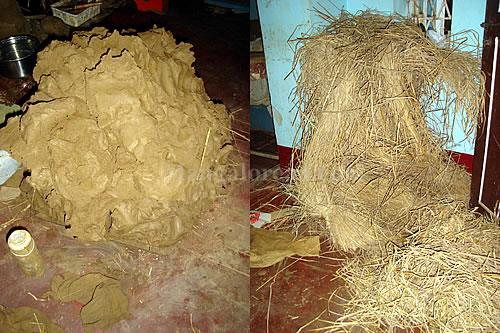
Prakash showed me the heap of clay, hay and the stack of small and large wooden platforms with wooden staff at the centre; “they are all there as ever, little more esthetically placed”, said Prakash. He has been visiting here every year for the last 15 years to get their family Ganesha idol.

When we removed our footwear and entered the hall cum work area, I was totally amazed to see the number of half completed and almost completed array of clay Ganesha models!


This I must confess was something I had never seen before! When I visited this place 29 years ago, it was to bring Peta and Basinga for my brother who was getting married in December 1978.

"Please come inside" - an ageing man, almost resembling Mohan Rao greeted us. A young man was sitting by the side, trying to shape the belly of the Ganesha model that he was working on. He turned back, got up and gave a broad smile too!

Prakash introduced me to them. The elderly man was Prabhakar Rao, eldest of the three sons of Mohan Rao. The young man was his son Mahesh. They both took us around the place and showed us unfinished models of Ganesha in different sizes. Prabhakar Rao's wife came out with cups full of hot badam milk and offered us seat on a cot inside the house. As we sipped the beverage, I saw Ganesha everywhere, leaving very little space in between for us to walk around!

Here is an interview with Prabhakar Rao and Mahesh Rao, which reveals the story behind the scene in making of Ganesha models.

Q: Who started this profession and when?
Prabhakar Rao: My father M Mohan Rao, born in 1895 was working in Bombay where he learnt the art of making clay models of Ganesha. He used to bring the idols from Bombay those days. He came back to Mangalore in 1932 and started it in Mangalore.

Q: I have heard about Mohan Rao since my childhood. He was close to my father. How many idols he used to make then?
Prabhakar Rao: Ever since he started making the Ganesha idols, the number has been steady at 183. Even the design is identical! While most of these are for worship within private house holds, 15 are worshipped in public places by Temples, Trusts or Associations including the largest of all which we make for 'Sangha Niketan'. It is an 8.5 feet tall idol which they used to order from Bombay initially, but we started making that for them since last 58 years.
Today, we carry out the good work of our late father, who passed away in 1988. We do get inquiries from new households and Associations but we politely refuse, owing to limitation of space and time!

Q: Tell me who all are involved within your family in making these.
Prabhakar Rao: Apart from me and my son Mahesh, my brother Sudhakar Rao, his son Rajesh and my youngest brother Ramachandra Rao, who is a Senior Manager in Vijaya Bank, join us in the good work. Ramachandra Rao takes leave from the Bank every year during this time! Apart from this, we have my sister’s sons Balakrishna, Venkatesh and Varadaraj and finally Ramachandra Rao’s son in law Deepak Rao actively participating in making these idols. Mahesh’s wife Seema, Venkatesh Rao’s daughter Kripa and Ramachandra Rao’s daughter Dr.Preetham who is doing her MD in Gynaecology also give a hand in painting the idols!

Q: That's great, the entire family working for a good cause, irrespective of their professions and qualifications! How much do you charge for the work?
Ramachandra  Rao: We don't charge for our services. We don't demand that at all! We are not doing this work to earn money. It is a service to the society that our elders started, and we are continuing it. People however; give us 'fee'(Kaanike) for our service according to their wish and capacity.

Q: Can you give us a picture about how you make these idols from raw materials?
Mahesh Rao: Yes. We get the processed clay from tile factories. They give us clay at concession. First stage is making the base of Ganesha on the wooden platforms. Once this dries up a bit, we go for the second stage, adding the bust and arms. In this stage, we use hay for support. Final stage is building the head and the trunk. Then we allow them to stand for some time and design the jewelry and the cloth, using tools that we have designed ourselves out of wooden and metal strips and blades! One specialty in our work is that we don't make these models using pre fabricated moulds. We shape them manually. It is a bit cumbersome process, but gives us lot of satisfaction. We smoothen the surface and allow the models to dry at room temperature for about a week. Then we paint them with different colours of enamel paints to give the final touch, almost one week before Ganesh Chaturthi.

Q: Do you get requests from outside Mangalore?
Sudhakar Rao: Not many. We make one for Farangipet and one for USA from where we have a party that has been taking Ganesha idol very year.

Q: What else do you do apart from crafting Ganesha idols?
Prabhakar Rao: We make Sharada Devi idols for Dasara Festival but only four, since Sharada pooja is performed mostly in public. We have printing and binding service for our livelihood. We also dress up Bridegrooms and design ‘Peta's and 'Basinga's that are essential for Hindu weddings.
Mahesh Rao: Yes. Many children come to us during Krishna Janmashtami for make up and fancy dress! We also dress them up for Mythological roles such as 'Narada' or 'Vishwamithra'!

We thanked the family members for the information they provided patiently, spending almost two hours with us, in spite of their busy schedule.

It is amazing to see three generations in a family involved in carrying out the trend set by Mohan Rao. The dedication that they are showing for the good work is heartening. Their skills are unquestionably excellent! In the modern generation of Plaster of Paris idols being in vogue, these clay models are still grafted by this family. The models they make, speak volumes about the selfless sacrifices the family is rendering year after year to uphold this ancient tradition that has kept not only the family united over the years, but also thousands of devotees of Lord Ganesha who get together every year to worship him in the form of these clay idols!


Today, the family is into Fourth generation, and they all join hands and make Ganesha idols. Demand is increasing year by year, and this year they have sculpted 204 idols, all with environmentally friendly materials like clay and lead free paint. My blogger friend from Chennai, Shrinidhi Hande was on a visit to his hometown Kota near Udupi and when he met me for the first time and asked me if anything exciting is happening in Mangaluru, I took him to Mohan Rao's place, which has been rebuilt with a strong spacious structure in place of their age old house.

There we also saw the majestic Ganesha of Sangha Niketan Mangaluru being decorated, and met Konchady Jeevanraj Shenoy, an aspirant young engineer who was personally fixing the 'Simhaasan'(Lion's Throne) for the Lord, with the help of an assistant. Prabhakar Rao the senior most member of the family, his brother Ramachandra Rao and their juniors were delighted to receive us and take us around the workshop. Their printing press is still functioning in a small room and women were seen printing and binding books. 

Overall, it was an overwhelming experience to see 204 Ganesha idols being prepared zealously but silently in our own neighbourhood Mannagudda by a family that has indulged in that activity since last 8 decades.

Please go through the pictures taken during my recent visit there.
 
 
Shrinidhi Hande with Prabhakar Rao
The Raos with Sangha Niketan Ganesha

Monday, August 8, 2016

Aa. Vai Jaa. Saa. - A Konkani Childrens' Movie with a Message

This is my first movie review. I don't watch movies since many years, unless I am specifically invited by someone and they ask me to cast my opinion about their movies. This is a special case, because the person who directed the movie is special to me. He is not only a family friend, but is also my role model who inspired me to take to sound recording and video movie production! He is none other than Dr. K. Ramesh Kamath, the sound recordist who turned film director, entrepreneur and vastu yogi. He also has the fame of directing the very first Saraswat Konkani film 'Jana Mana'.

When I first saw Dr. K. Ramesh Kamath active on social media about 6 years ago, I had the least imagination that he was the same Ramesh Kamath who had graduated from the Film and Television Institute of India, Pune, specialising in Sound Recording! There was a reason, and that reason was, Dr. Kamath prefixed the title 'Vastu Yogi' to his name. I don't have the habit of getting too personal with people, or asking directly about their past, but when Dr. Kamath became my friend on Facebook, I slowly developed a doubt that this could be the same Ramesh Kamath whom my brother Krishnakanth had been telling me about, in 1972! Dr. Kamath's wife Kiranmayi Kamath was already in my friend list, and when she asked me one day about the whereabouts of my brother who was a friend of Dr. Kamath in Mysore during his medical studies, I could complete the jigsaw puzzle and be affirmed about who Vastu Yogi Kamath was!

I was overjoyed to have him as my facebook friend for two reasons.

1. In 1972 as soon as I completed SSLC and was thinking about future studies, my brother Krishnakanth told me about the promising job oriented course at FTII Pune, with which his friend Ramesh Kamath had graduated.

2. I was not allowed to join FTII then, but I worked for a Bank for 22 years and in the Eighies when I saw the first Saraswat Konkani film 'Jana Mana' directed by Ramesh Kamath on Doordarshan, I developed great respect for him. He had become a film director from sound recordist already in 1980!

Dr. Kamath also fondly remembered his hey days in the early Seventies when he along with Dr. P. Dayananda Pai the famous Konkani tycoon and philanthropist, had played my late father Kudpi Vasudeva Shenoy's Konkani drama 'Dolyaan Khelu' in Mysore during the Ganesha Festival.

So, my urge to meet Dr. K. Ramesh Kamath(Vastu Yogi) in person multiplied when I interacted with him on Facebook for over 6 years, but we never had a chance to meet in spite of me visiting Bengaluru and him visiting Mangaluru often!

Then one day I received a private message from him, explaining about his plans to make the second and 'last Konkani film of his life', this time with a theme suited for children, a simple story with a message for meaningful living. He also said, name of the movie 'Aa. Vai. Jaa. Saa.' may sound odd, but it had meaning wihin and that is the main theme of the movie. He was already through with the story and script, he had chosen a few actors already and was scheduled for shooting during the end April this year at Udupi, Kallianpur and surrounding places. He also asked me whether I am interested in doing a role, he sought my assistance with media contacts and I assured him the best of my support and also gave him contact addresses, phone numbers and email addresses of those media friends whom I knew personally. That was the least I could do for him or our mother tongue Konkani. Acting part remained a suspense for me, as Dr. Kamath does quick thinking and he went full swing with the shooting schedule as he had planned it, and before I could think or wink, he started updating about the progress of the film shooting, editing, dubbing and other technical aspects!

Well, Dr. Kamath is a dedicated person who leaves no stone unturned when it comes to film making. He employed a good technical crew, camped in and around Udupi and completed the work amazingly faster than expected, using the latest technology, that is Drone camera for aerial shots. He also went for digital editing and mixing, audio dubbing done in Mangaluru and Bengaluru and post processing done entirely in Bengaluru.

When the North American Konkani Convention was held in Atlanta in early July this year, Dr. Kamath had the previlege of screening the preview of the film Aa. Vai. Jaa. Saa. there and he called it World Premier. He was honoured with accolades there by the organisers and the delegates, and his dream of taking Konkani film to global level was thus fulfilled!  

What a way to start!

Then the film certification by the censor board was a cakewalk, as the movie had zero violence, no masala, no rape, no fights, no romantic scenes, rather no stereotype scenes that one may expect in Indian Commercial Cinema! This is more like a documentary film with a good message rather than a commercial formula.

Thus Dr. K. Ramesh Kamath's dream came true, and the film was set for release in Mangaluru first. Dr. Kamath booked Bharath Big Cinemas for three free shows on August 9, 10 and 11 apart from a special Grand Premier on August 6. All the shows have been sponsored by Konkani entrepreneurs and philanthropists who always supported any activities undertaken by Konkani scholars.

Dr. Kamath called me and personally invited me over phone, and thus I had the honour and privelege of watching the movie on August 6 as guest at the Grand Premier, and it was also the first time that I met Dr. Kamath in person!

Left to right: Dr. Ramesh Kamath, Gopinath Bhat, Kudpi Raj and Kemthur Kamath
It was an emotional meeting when Dr. Kamath received me in the lounge of Bharath Big Cinemas at around 5:30pm on August 6, and first thing he did was to hug me tight and say "This is for real! I am so happy to meet you in person, Kudpi Ji! Please watch the movie and give me your honest reveiw. I deem you opinion valuable!"

That was more than graduation for me from FTII when those words came from a great scholar Dr. Kamath's mouth, and he was candid in his expression. His broad smile and energy levels amazed me! His simplicity blew me off! One dream of mine to meet my role model was fulfilled. Next remained the herculean task of reviewing his film!
With Dr. Ramesh Kamath, Nagendra Rao, Pramod Kamath, Kemthur Kamath and Karthik Shenoy
The show began after welcome speech by Dr. Kamath and formal speeches by a few guests of honour such as Dr. Richard Castelino the noted film director and Konkani Sardar Basti Vaman Shenoy. They appreciated the job done by Dr. Kamath almost at the dusk of his career as film director, that too directing a Konkani Childrens' Movie. Dr. B. Devadas Pai, Registrar of Karnataka Konkani Sahitya Academy, partner of Taj Mahal Cafe Kudpi Madhava Shenoy, Editor of Kodial Khaber M Venkatesh Baliga, actor Dinesh Prabhu and other dignitaries were present on the dais. 
Dignitaries on the dais before the show began

Review of Aa. Vai. Jaa. Saa.:
Aa. Vai. Jaa. Saa. is produced by Film India Productions, led by a youngster Ms. Mallika. Film India Productins is a film production company registered at the Karnataka Film Chamber of Commerce. Though Aa. Vai. Jaa. Saa. is the first Konkani film produced by Film India Productions, Ms. Mallika has the experience of working as production incharge of Kannada films like Prema Kavya, Sanjeyalli Aralida Hoovu and Muttina Pallakki.

Dr. K. Ramesh Kamath, the director of the film is a graduate from FTII Pune, and his earlier Konkani film 'Jana Mana' released in 1980 has won hearts of Konkani critics the world over. That film was also recognised as the first Sarawat Konnkani film produced. After 36 years he has directed the third Konkani film, his second. Second one was 'Ujwaadu' produced by Mitra Media under the partnership of Dhananjaya and Anuradha Padiyar, directed by Kasargodu Chinna which won National Award for a regional language film.

Theme: Theme of the film is simple. It is based on the Four 'S' principles of life, AAdhyatmik(Spiritual), VAIjnanik(Scientific), JAAtyatit(Secular) and SAAmajik(Social). Abbreviations of these four principles for a meaningful living Aa. Vai. Jaa. Saa. complete the title of the movie!

The story revolves around four brilliant, talented students of a school in Kallianpur, Udupi. The school conducts extra-curricular activities from time to time, to make the students all rounders in every respect. The four students, a Hindu, a Muslim, a Christian and a Dalit win a fancy dress competition with their own themes Aadhyatmik, Vaijnanik, Jaatyatit and Saamajik. They are recognised by the patron of the school, Sathya Swami, who has an ashram where he preaches values of life through his own principals 'Aa. Vai. Jaa. Saa.' and he adopts the four children and makes them develop the art of self realisation and serving humanity by using their respective passions combined to bring peace and harmony which is need of the hour in present day uncertainty where people fight among each others in the name of religion, blind belief, hatred, jealousy and misery.

He takes them to his ashram and through a magician explains them the importance of those four principles, quoting examples of noted people who helped build a strong India. He also teaches them to lead the path of tolerance for each others' religion caste and social status. Thus they become role models for their school, and during subsequent picnics they learn many things, they also try and rehabilitate their arrogant or misled parents! How well they succeed in bringing changes in the society using Dr. Kamath's formula inculcating the four 'S' elements Aa. Vai. Jaa. Saa. is to be seen on the big screen to be understood fully.

Cultural arts of undivided Dakshina Kannada district such as Yakshagaana and Puppet Show(Uppinakudru Bombeyaata) have been exhibited in the film. A trip to 'Snehalaya', charitable home for the destitute run by Joseph Cresta has been highlighted. Beauty of nature, forest, sea, beaches and and St Mary's Island have been captured with drone camera, and the cinematographer has done a wonderful job. Witchcraft, darshana and perils of alcoholism have been cleverly touched, educating the younger generation about the social awareness they should develop. A Kannada moral story that I had read in my late father's Ondaanemaale book named "Eejalu Tilidideye?" about a scholar visiting a village, crossing the river while testing the boat operator about his qualifications has been well enacted by Gopinath Bhat, veteran stage and film actor. Muslim donating blood to save a Hindu Brahmin priest has been meaningfully picturised. 

Dr. Ramesh Kamath has acted as the sutradhar 'Sathya Swami', and has done full justice to his role. The four children played by Sarthak Shenoy, Shreyas Kamath, Samarth Shenoy and Spandana V. Pai have acted very well. Rest of the main actors, Vasudha Prabhu, Zita Usha Fernandes, Karthik Shenoy, Dinesh Prabhu(He was the hero of Dr. Kamath's earlier film Jana Mana as well), P.R. Nayak, Dr, Mahesh Shenoy, Chempi Ramachandra Bhat, Sathish and Santhosh Kullappa Pai, Om Ganesh Kamath, Joseph Cresta and others have done justice to their roles. There are many first timers who have acted or contributed their voices, but they have done that honestly and without any monetary expectations. That is highly commendable.

Though the film has few minor technical glitches like voice dubbing synchronisation at places, considering the fact that it is a low budget movie spending just Rs.25 Lakhs and also the no profit motive by the producers and the director, the movie is worth watching. The theme being mainly communal harmony and social integrity through scientific outlook, is worth considering for a National Award, and I hope and wish the team success in this direction.

The film runs for 73.22 minutes and has one main theme song sung by Shankar Shanbhogue, Mahalaxmi Shenoy, Ankit Kundu and Abhinav. Background score is by Diwaan Giridhar and MM Yashas. 
Other technical details:
Story, Screenplay, Lyrics, Direction: Dr. K. Ramesh Kamath
Assistant Director: Karthik Shenoy
Production: Mallika, Film India Productions
Cinematography: Ramesh Koira
Editor: Arun P Thomas
Art Direction: Swamy
Costume Designers: Vinutha Kiran, Kemthur Kamath
Sound recording/Mixing(DTS): Abhinath
Sound Dubbing: Shinoy V Joseph, CAD Media
Publicity Design: Sanjay Chapolkar
Colour Grading and DI: Mathew

Monday, March 21, 2016

Going Nuts over Spring

Pic source: www.currylore.com 
"Spend carefully, don't buy things that you can't digest, avoid oily stuff and make sure that you are not left hungry".

Those were the words spoken by our father as he gave 50 Paise each, to me and my brother Radhakanth for spending over coffee and snacks at a make shift canteen at our school, Besant Basic School on MG Road, Mangalore. That was Tuesday the February 22, and it was the annual 'Vasantotsava' or Spring Festival of 1966 celebrated in the school. Variety entertainment and the food stall made it more attractive than school day. We never missed that day for the initial five years we spent in that school.

As we walked up the MG Road passing by the green paddy fields on either side, Radhakanth said "They must be having quite a few food items there. I would prefer to eat some halwa, some snack and have lemon juice. What is your idea?"

I was not sure myself. I told him that I shall decide after seeing the canteen.

We reached school little after 5:45PM and the entertainments were to begin at 6:00. I met my classmates Naveen Kini, Prasad Basri, Ravi Kumar, Sathish Kodialbail and Aravind Thodar. Radhakanth was looking here and there, and before I could turn around, he had disappeared and next I saw him in the make shift canteen set up in 5th Standard class room, sitting on a bench and eating something! He waved at me and signalled me to join him. I nodded my head and showed him my tummy, meaning I am full and I may eat something later! Radhakanth came out of the canteen, joined use and told me, "They have nice Wheat Halwa, Avalakki, Ambade, Sajjige, Sheera, Holige, Tukudi, Sherbat and coffee. I ate halwa, holige and drank sherbat. You can also do that. Each item costs 15 Paise. I still have 5 Paise left and I can use it for something tomorrow."

I was still not tempted to eat anything. Besides, couple of other classmates didn't have any pocket money with them. So, I didn't feel like depriving them!

Then the show began, some entertainment programme went on until 9:00PM. I was eyeing the other students entering and hogging at the canteen lit by petromax light but I could not make up my mind about spending the 50 Paise for anything at the canteen. After two or three rounds on the school ground peeping into the canteen to see the activities there, at 8:30PM they closed the canteen and I sighed with disappointment, that I could not have anything there! The description of the halwa, holige and sherbat made me drool, for I was feeling hungry already! Radhakanth was with Mahaveer and other friends; I was with Naveen, Prasad and Ravi when we returned home. As we approached Ballal Bagh and crossed Narayana Shetty's shop Lalbagh Stores, I saw 'Baayi's Shop' still open. It was almost 9:15PM then.

I asked Naveen "What can I take home with this 50 Paisa I have in my pocket?"

Naveen's eyes brightened, and he said, "Hey buy nelakadale..... peanuts. Baayi sells whole peanuts with shell for 50 Paise a Ser. All at home will be happy that you have brought peanuts, much more than anyone can even imagine! Your parents will feel proud, that you didn't spend the money for yourself, but you shared peanuts with them!"

Prasad and Ravi also nodded in approval, and I didn't hesitate to climb the three steps into Baayi's shop and ask for one ser peanuts! Baayi's eyes became as big as a car's headlight, and she seemed to be shocked! I repeated what I asked for, and showed her the Fifty Paise coin with a broad smile. She packed the peanuts in a large paper cone and handed it over to me.

I came home running with the pack, dashed straight into the hall into the dining section and handed over the pack to my mother. My three brothers who were having dinner were surprised to see that, and they exchanged gestures within themselves. Radhakanth was sitting beside my father who was relaxing at the other end of the hall smoking cigarette and reading English newspaper.

Mother was aghast when she saw the pack, and she asked me what it was. I jubilantly replied "Nelakadale. I got it from Baayi's shop. She gave one Ser for 50 Paise. We all can eat as much as we want!"

Mother announced to father "Look here I say! He has brought one ser peanuts instead of having snacks and coffee at school!"

Father kept his paper aside, stubbed the cigarette in ash tray, lifted his head and stared at me. Then he shouted "Are you crazy? I gave you money and told you to spend it carefully on snacks and drink at the school canteen and you brought peanuts? Learn something from your brother Radhakanth! He spent 45 Paise for snacks and a drink and also returned 5 Paise. Now go to Baayi's shop immediately and return the peanuts. Otherwise you are not allowed to enter the house!"

Radhakanth was making faces at me and smiling triumphantly!

I pleaded; I cried and tried all that I could, to convince my parents. When they didn’t respond favourably, I went out with the conical paper pack containing the peanuts, sat near the gate on the cement platform and started to sob. Across the MG Road in a distance, I could see Baayi just closing her shop. Nemanna appeared from nowhere, he was nearing me with unsteady steps.

Nemanna(Konde Nemiraj Shetty) was an eternal bachelor, a senior person related to our neighbours, staying in the outhouse behind our home. He had the habit of getting loaded with hooch daily and come home in an inebriated state.

He neared me, sat by my side and whispered with a strong breath that smelled like sapodilla fruit, "Appu…. Rajani.... why are you sitting here at late hours? Did you do anything wrong for which you are punished? Tell me what happened!"

I cried aloud and told him everything. He consoled me, held my hand and led me back to our main door. He knocked on the door and called for my father. Father appeared and asked Nemanna, "Why Nemanna? What happened?"

Nemanna was indignant, as he put me in front of him, "Kudpi sir, you did not do the right thing. I respect you for your age, wisdom and abilities. Sending this innocent boy out of home for none of his mistakes is wrong. I won't support that. He brought one Ser peanuts with a good intention of sharing them with all at home, suppressing his wants, his hunger. Please think about his sacrifice and don't punish the poor child. How can he return the peanuts at this hour when Baayi has closed her shop! He will return it tomorrow morning. Right Appu?"

I nodded while sniffs, tears and hiccups appeared then and now, the after effects of crying and feeling helpless!

Father looked at me and said "Nemanna, do you think I am cruel enough to punish my child? I just wanted to teach him the value of money and discipline in life. Had you not brought him in, I'd have done that myself after a few minutes. Anyway, forget the whole episode. We shall consume the peanuts tomorrow as punishment to this boy! Rajani my dear son, keep in mind that this is the last time you did mistake like this. You should not take liberties like this and buy just about anything out of your pocket money. You are too small to decide what you want. Your friends are not mature enough to guide you. Always obey your parents and be responsible in life. Now go inside, wash your hands, feet and face, change your clothes. Your amma is waiting to serve you dinner"

I did not fail to notice Nemanna and my father wink at one another and smile! I also could not understand why Radhakanth who spent his pocket money for himself was right, and I who brought a heap of peanuts for the entire family to enjoy, was wrong!

Wednesday, December 9, 2015

ಮಣ್ಣಗುಡ್ದೆ ದಿಡುಂ

ಎಪ್ಪತ್ತರ ದಶಕದ ಡಿಸೆಂಬರ್ ತಿಂಗಳ ಒಂದು ಬೆಳಿಗ್ಯೆ ನವಭಾರತ ದಿನಪತ್ರಿಕೆಯನ್ನು ಓದುತ್ತಿದ್ದ ನಾನು, ಕೊನೇಯ ಪುಟದಲ್ಲಿ 'ನಾಳೆ ಮಣ್ಣಗುಡ್ದೆಯಲ್ಲಿ ದಿಡುಂ' ಎಂಬ ಶೀರ್ಷಿಕೆಯನ್ನೋದಿ ಹೌಹಾರಿದೆನು!

ಹೌದು. ಪ್ರೊಫ್ ರೀಡರ್‍ಗಳ ಅಲಕ್ಷ್ಯದಿಂದಾಗಿಯೋ ಅಥವಾ ಹೆಚ್ಚಿನ ಹಳೇ ಕೈಗಳು ಮಣಿಪಾಲದಲ್ಲಿ ಹೊಸದಾಗಿ ಪ್ರಾರಂಭವಾದ ಉದಯವಾಣಿ ದಿನಪತ್ರಿಕೆಯತ್ತ ಆಕರ್ಷಿತರಾಗಿ ಅತ್ತ ನೆಗೆದ ಕಾರಣ ಅನುಭವಿಗಳ ಕೊರತೆಯಿಂದಾಗಿಯೋ ಅಂದಿನ ದಿನಗಳಲ್ಲಿ ನವಭಾರತ ಹಲವಾರು ತಪ್ಪುಗಳನ್ನು ಹೊತ್ತುಕೊಂಡು, ಸೋತು ಬಳಲಿ ನಮ್ಮ ಕೈಸೇರುತ್ತಿದ್ದುದಂತೂ ಹೌದು! ನಮಗಂತೂ ನವಭಾರತದಲ್ಲಿ ಪ್ರಕಟವಾಗುತ್ತಿದ್ದ  'ಶಿಂಗಣ್ಣಾ' ವ್ಯಂಗ್ಯಚಿತ್ರ, 'ಅರ್ಥಗರ್ಭಿತ ವಾರ್ತೆಗಳು' ಮತ್ತು ಸಿನೆಮಾ ಟಾಕೀಸುಗಳ ಜಾಹೀರಾತುಗಳನ್ನು ನೋಡದೇ ಬೆಳಗಾಗುತ್ತಿರಲಿಲ್ಲ! ಕ್ರೀಡಾಪುಟದಲ್ಲಿ ಚಂದ್ರಶೇಖರ್ ಚಿತ್ರಕ್ಕೆ ವೆಂಕಟರಾಘವನ್ ಹೆಸರು, 'ಜೋ ಡಾನ್ ಬೇಕರ್ ಆಸ್ ಮಿಚೆಲ್' ಎಂದು ಹಾಕಲು 'ಜೋ ಡಾನ್ ಮಿಚೆಲ್ ಬೇಕರೀಸ್' ಇತ್ಯಾದಿ ತಪ್ಪುಗಳನ್ನು ಕಾಸಿಗೊಂದು ಕೊಸರಿಗೊಂದರಂತೆ ನೀಡಿ, ಪುಕ್ಕಟೆ ಮನೋರಂಜನೆ ನೀಡುವ ದಿನಪತ್ರಿಕೆಯನ್ನು ನಾವು ಅದು ಹೇಗೆ ಓದದೇ ಇರಲು ಸಾಧ್ಯ....ಹೇಳಿ!

ಅಂದ ಹಾಗೆ, ಇದು ಕೇವಲ ನವಭಾರತದ ಬಗ್ಗೆ ಬರೆಯಲು ಉದ್ದೇಶಿಸಿದ ಲೇಖನವೆಂದು ಅನ್ಯಥಾ ಭಾವಿಸಬಾರದು. 'ಮಣ್ಣಗುಡ್ದೆಯಲ್ಲಿ ದಿಡುಂ' ಒಂದು ಉಲ್ಲೇಖ ಅಷ್ಟೇ! ಮಣ್ಣಗುಡ್ದೆ ದಿಂಡು ನಾಳೆ ಅನ್ನುವಾಗ ಇಂದು 'ದಿಡುಂ' ಎಂದು ಗರ್ನಾಲ್ ಸ್ಫೋಟಿಸಿ ನಮ್ಮನ್ನು ಹೌಹಾರಿಸಿದ್ದಕ್ಕಾಗಿ ನಾನು ನವಭಾರತವನ್ನು ಉಲ್ಲೇಖಿಸಬೇಕಾಯಿತು.

ಮಣ್ಣಗುಡ್ದೆ ದಿಂಡಿನ ಸಂದರ್ಭದಲ್ಲಿ ಗರ್ನಾಲು ಸಿಡಿಸುವುದು ಸಾಮಾನ್ಯ. ಸಾಯಂಕಾಲದಿಂದ ರಾತ್ರಿ ವರೇಗೆ ಗಿರ್‍ಗಿಟ್ಲಿಯಂತೆ ಬಲ್ಲಾಳ್‍ಬಾಗ್‍ನಿಂದ ಮಣ್ಣಗುಡ್ದೆಗೆ ಹಾಗೂ ಹಿಂದೆ ಬಂದು ಆಯಾಸವಾಗಿ ನಾವು ಗಾಢ ನಿದ್ರೆಯಲ್ಲಿದ್ದಾಗ ಗರ್ನಾಲಿನ ಶಬ್ಧಕ್ಕೆ ಎಚ್ಚೆತ್ತು ಗಡಿಬಿಡಿಯಿಂದ ಎದ್ದು ಮುಖಕ್ಕೊಂದಿಷ್ಟು ತಣ್ಣೀರೆರಚಿ, ಬೈರಾಸಿನಿಂದ ಒರೆಸಿ, ಹೊರಗೋಡಿ ಕಂಪೌಂಡ್ ಗೋಡೆಯನ್ನೇರಿ ಕುಳಿತು, ಝೈಂ ಝೈಂ ಬ್ಯಾಂಡ್ ವಾದನದ ತಾಳಕ್ಕೆ ತಕ್ಕಂತೆ ಕುಣಿಯುತ್ತಾ ವೈಯ್ಯಾರದಿಂದ ಮೈ ತಿರುಗಿಸುತ್ತಾ ಗಂಭೀರತೆಯ ಮುಖಮುದ್ರೆಯೊಂದಿಗೆ ಸಾಗಿ ಬರುವ ತಟ್ಟಿರಾಯ, ರಾಣಿಯರನ್ನು ಕಂಪೌಂಡ್ ಪಕ್ಕದಿಂದ ಸಾಗುವ ದೃಶ್ಯವನ್ನು ಕಣ್ತುಂಬಾ ಕಾಣುವುದೇ ಒಂದು ಖುಷಿ! ನಂತರ ಬಂಡಿಯನ್ನೇರಿ ವಾಲಗದ ಧ್ವನಿಗೆ ಹಿಂಬಾಲಿಸಿ ಬರುವ ಗ್ರಾಮ ದೇವರ ಮೂರ್ತಿ ಗುರ್ಜಿಯನ್ನೇರಿ ಪೂಜೆಯನ್ನು ಸ್ವೀಕರಿಸುವಾಗ ಮೊಳಗುವ ಕೊಂಬು, ಭಗವತಿ ಕ್ಷೇತ್ರದ  ಗೂನುಬೆನ್ನಿನ ರಾಮ, ಮತ್ತವನ ಮೇಳದ ಚಂಡೆವಾದ್ಯ, ಸಿಡಿಸುವ ಮತಾಪು, ಪಟಾಕಿ ಎಲ್ಲವೂ ಕಣ್ಮುಂದೆ ಇಂದಿಗೂ ಮಾಸದೇ ಉಳಿದಿದೆ, ಕಿವಿಯಲ್ಲಿನ್ನೂ ಮೊಳಗುತ್ತಿದೆ!


ಇನ್ನು 'ಮಣ್ಣಗುಡ್ದೆ ದಿಂಡು' ಅಂದರೇನು, ಎಂದು ತಿಳಿದುಕೊಳ್ಳೋಣ. ಈ 'ಮಣ್ಣಗುಡ್ದೆ ದಿಂಡು' ಅನ್ನುವಂತಹದು ಪ್ರತಿ ವರ್ಷ ನವೆಂಬರ್ ಅಥವಾ ಡಿಸೆಂಬರ್ ತಿಂಗಳಲ್ಲಿ ನಡೆಯುವ ಉತ್ಸವ. ಕನ್ನಡ ಭಾಷೆಯಲ್ಲಿ ದಿಂಡು ಅಂದರೆ ಉತ್ಸವ ಎಂದು ಅರ್ಥವಿದೆ. ಇಲ್ಲಿ ದಿಂಡು ಎಂದರೆ ಗುರ್ಜಿ ಉತ್ಸವ. ಗುರ್ಜಿ ಅನ್ನುವುದು 'ಗುಜ್ಜು' ಅಥವಾ ಮರದ ಕಂಬಗಳನ್ನು ನೆಟ್ಟು ಬಿದಿರಿನ ಮುಕುಟ ಕಟ್ಟಿ ಕೆಂಪು ಬಿಳಿ ಪತಾಕೆಗಳನ್ನು ಸುತ್ತಲೂ ನೇತಾಡಿಸಿ, ಭುಜಕ್ಕಿಷ್ಟು, ಸೊಂಟಕ್ಕಿಷ್ಟು ತರಕಾರಿ ಹಣ್ಣು ಹಂಪಲು ವೈವಿಧ್ಯಗಳನ್ನು ಕಟ್ಟಿ, ಕಂಬಗಳಿಗೆ ಅಡಿಕೆಯ ಮಾಲೆಯನ್ನು ಸುತ್ತಿ, ನಲಿದಾಡುವ, ಓಡಾಡುವ ಬಣ್ಣಬಣ್ಣದ ವಿದ್ಯುದ್ದೀಪಗಳಿಂದ ಅಲಂಕರಿಸಿ ಝಿಗ್ಗನೆ ಮಾರು ದೂರ 'ಮಾರನ ಅರಮನೆಯಂತೆ' ಎದ್ದು ಕಾಣುವಂತೆ ಮಾಡುವ ಮೋಡಿ ನಮ್ಮ ಚಿಕ್ಕಂದಿನಿಂದ ಇಂದಿನ ವರೇಗೆ ವರ್ಷಂಪ್ರತಿ ಬೆಳೆದು ಬಂದು ಇಂದಿಗೂ ಸಾವಿರಾರು ಜನರನ್ನು ಆಕರ್ಷಿಸುತ್ತಿದೆ. ನಮ್ಮ ವಾಸಸ್ಥಾನ ಬಲ್ಲಾಳ್‍ಬಾಗ್ ಹಾಗೂ ಸಮೀಪದ ಮಣ್ಣಗುಡ್ದೆಯಲ್ಲಿ ಮುಖ್ಯವಾಗಿ ನಿರ್ಮಿಸುವ ಗುರ್ಜಿಗಳಲ್ಲದೇ ಮಣ್ಣಗುಡ್ದೆಯಿಂದ ಅಳಕೆಗೆ ಹೋಗುವ ದಾರಿಯಲ್ಲಿ ಕೃಷ್ಣ ಮಠದಲ್ಲಿ, ಒಂದು ಚಿಕ್ಕ ಕಡಲೆಕಾಳಿನ ಗುರ್ಜಿಯನ್ನೂ ನಿರ್ಮಿಸುತ್ತಿದ್ದರು. ಅದರ ವೈಶಿಷ್ಟ್ಯ ಏನೆಂದರೆ, ಅಡಿಕೆಯ ಬದಲು ನೀರಲ್ಲಿ ನೆನೆಸಿದ ಕಡಲೆ ಕಾಳಿನ ಮಾಲೆಯನ್ನು ಗುರ್ಜಿಯ ಕಂಬಗಳಿಗೆ ಸುತ್ತುವುದು. ಉತ್ಸವದ ಮಾರನೇ ದಿನ ಗುರ್ಜಿಗೆ ಕಟ್ಟಿದ ತರಕಾರಿ ಹಣ್ಣುಹಂಪಲುಗಳನ್ನು ಏಲಂ ಹಾಕಿ ಮೂರು ಅಥವಾ ನಾಲ್ಕು ಪಟ್ಟು ಬೆಲೆ ಸಂಗ್ರಹಿಸುತ್ತಾ ಇದ್ದರು. ಆ ಏಲಂ ನೋಡುವುದು ಮತ್ತೊಂದು ಕುತೂಹಲ ನನಗೆ! ವಿಕ್ರತ ಕಾಡು ಅನನಾಸು ತಿನ್ನಲು ಯೋಗ್ಯವೇ ಎಂಬ ಯೋಚನೆ. ಗೇರುಹಣ್ಣಿನಂತೆ ಕಾಣುವ ಸೇಬು ಹಾಗೂ ಅದಕ್ಕೆ ಪೋಣಿಸಿದ ಗೇರುಬೀಜ ಯಾರು ಕೊಳ್ಳುವರೆಂಬ ಕೌತುಕ! 

ಶಾಲೆಗೆ ಹೋಗಲು ಪ್ರಾರಂಭಿಸಿದ ನಂತರ ಮೊದಲು ಅಮ್ಮ ಅಥವಾ ಅಣ್ಣಂದಿರ ಕೈ ಹಿಡಿದು ಮೆಲ್ಲನೆ ಹೆಜ್ಜೆ ಹಾಕುತ್ತಾ ಮಣ್ಣಗುಡ್ದೆಯತ್ತ ನಡೆದು ದಾರಿಯಲ್ಲಿ ಅಲ್ಲಲ್ಲಿ ಐಸ್‍ಕ್ಯಾಂಡಿ ಮಾರುವವರನ್ನು, ಪುಗ್ಗೆ, ಪೀಪಿ, ಟಾಂಟಾಂ, ಬೊಂಬೆಗಳನ್ನು ಮಾರುವವರನ್ನು, ಬೊಂಬಾಯಿ ಮಿಠಾಯಿ, ಬೊಂಬಾಯಿ ಖಿಲೋನಾಗಳನ್ನು, ಚಕ್ರ ತಿರುಗಿಸಿ ಒಂದು ಮುಷ್ಟಿ ನೆಲಕಡಲೆ ಗೆಲ್ಲಬಹುದಾದಂತಹ 'ರಷ್ಯನ್ ರೂಲೇ' ಮಾದರಿಯ ಜೂಜಿನ ಚಕ್ರಗಳನ್ನು, ರಟ್ಟಿನ ದೊಡ್ದ ಬೋರ್ಡಿಗೆ ಬಣ್ಣದ ಕಾಗದ ಸುತ್ತಿದ ಚಿಕ್ಕ ಚಿಕ್ಕ ಪೊಟ್ಟಣಗಳನ್ನು ಅಂಟಿಸಿ ಅವುಗಳೊಳಗೆ ಅದೃಷ್ಟದ ಸಂಖ್ಯೆ ಇರಿಸಿ ಬಹುಮಾನ ಗೆಲ್ಲಿಸುವ ಮಂದಿ, ರಿಂಗ್ ಬಿಸಾಡಿ ಸಾಬೂನು, ಸ್ನೋ, ಆಟಿಕೆ, ಬಿಸ್ಕತ್ತಿನ ಪೊಟ್ಟಣ ಇತ್ಯಾದಿಗಳನ್ನು ಗೆಲ್ಲಬಹುದಾದ ಸ್ಟಾಲು,  ಚರುಮುರಿ, ಮುಳ್ಳುಸೌತೆ, ವಿಮ್‍ಟೋ, ಗೋಲಿ ಸೋಡಾ, ಖರ್ಜೂರ ಮಾರುವವರನ್ನು ತದೇಕಚಿತ್ತನಾಗಿ ದೃಷ್ಟಿಸಿ, ಒಂದು ದಿನ ನಾನೂ ಇವರಂತೆ ರಸ್ತೆ ಬದಿ ಸ್ಟಾಲ್ ಇಟ್ಟು ಒಬ್ಬ ದೊಡ್ದ ವ್ಯಾಪಾರಿ ಆಗುವ ಕನಸು ಕಾಣುತ್ತಿದ್ದೆ!

ನನಗೆ ನೆನಪಿದ್ದಂತೆ, ನಾನು 1962ರಿಂದ ಬಲ್ಲಾಳ್‍ಬಾಗ್ ವೀರ ಭವನದಲ್ಲಿನ ನಮ್ಮ ವಾಸದ ಮನೆಯ ಕಂಪೌಂಡ್ ಗೋಡೆಯ ಮೇಲೇರಿ  ಕುಳಿತು ಬಲ್ಲಾಳ್‍ಬಾಗ್ ವೃತ್ತದಲ್ಲಿ ಹತ್ತು ಸಮಸ್ತರು ಸೇರಿ ನಿರ್ಮಿಸಿ ಪೂಜಿಸುತ್ತಿದ್ದ ಗುರ್ಜಿಯನ್ನು ಕಾಣುತ್ತಿದ್ದೇನೆ. ಈ ಗುರ್ಜಿಯ ಮರಮಟ್ಟುಗಳನ್ನು ಲಾಲ್‍ಬಾಗ್ ಸ್ಟೋರ್ ಮಾಲಿಕ ನಾರಾಯಣ ಶೆಟ್ಟಿಯವರ ಕಟ್ಟಿಗೆ ಡಿಪೋ‍ದ ಅಟ್ಟದಲ್ಲಿ ಕೂಡಿಡುತ್ತಿದ್ದರು. 

ಬಲ್ಲಾಳ್‍ಬಾಗ್‍ನಲ್ಲಿ ಅರುವತ್ತರ ದಶಕದ ಕೊನೇಗೆ ಪ್ರಾರಂಭವಾದ 'ಕೊಡಿಯಾಲ್‍ಬೈಲ್ ಯೂತ್ ಕ್ಲಬ್' ದಿಂಡಿನ ವೇಳೆ ಸಕ್ರಿಯವಾಗಿ ಮನೋರಂಜನಾ ಕಾರ್ಯಕ್ರಮಗಳನ್ನು ಏರ್ಪಡಿಸಿ ಸ್ಥಬ್ದಚಿತ್ರವನ್ನು ಸಜ್ಜುಗೊಳಿಸಿ ಭಾರತ ಮಾತೆಯಂತೆ ವೇಷ ಧರಿಸುವ, ಆರ್ಕೆಸ್ಟ್ರಾ ಜೊತೆ ಮೈಕ್‍ನಲ್ಲಿ ಜೋರಾಗಿ "ಅಜ್ಜಾ ಅಜ್ಜಾ....ಈರೆಗ್ ಕೆಬಿ ಕೇಣುಜ್ಜಾ....." ಎಂದು ತೀಸ್ರಿ ಮಂಜಿಲ್ ಸಿನೆಮಾ ಹಾಡಿನ ರಾಗಕ್ಕೆತುಳುವಿನಲ್ಲಿ ಇಂಪಾಗಿ ಹಾಡುವ ರಾಜ್ ನರೇಶ್, 'ಇಸ್ಕ್ ಇಸ್ಕ್....' ಎಂದು ಕೂಗುತ್ತಾ ಡ್ಯಾನ್ಸ್ ಮಾಡುವ ಪೈಲ್ವಾನ್ ಲೂಯಿಸ್, ಪ್ರಕಾಶ, ರಮೇಶ್ ಆಚಾರಿ, ಜಯ, ಕಾಶಿನಾಥ, ಏಕನಾಥ, ರವಿ ಕುಮಾರ, ಗಣೇಶ ಮತ್ತು ಇತರ ಮಿತ್ರರು ನೀಡಿದ ಪುಕ್ಕಟೆ ಮನರಂಜನೆ ಇಂದಿಗೂ ಮರೆತಿಲ್ಲ ನಾನು.

ಮಣ್ಣಗುಡ್ದೆ ಗುರ್ಜಿಯ ಹಿಂಭಾಗದ ಖಾಲಿ ಸ್ಥಳದಲ್ಲಿ ಮರದ ಕುದುರೆ ಮತ್ತು ತಿರುಗು ತೊಟ್ಟಿಲು ಆಟದ ಸಂತೆ ಒಂದು ವಾರ ಮುಂಚಿತವಾಗಿ ಸ್ಥಾಪನೆಯಾಗಿ, ತೆಂಗಿನ ನಾರು ಸಿಕ್ಕಿಸಿ ತೊಟ್ಟಿಲು ತಿರುಗುವಾಗ ಮಾಡುವ ಕುಯ್ಂ.... ಕುಯ್ಂ.... ಕಿರ್ರ್.... ಕಿರ್ರ್.... ಶಬ್ಧವನ್ನು ಕೇಳಿ, ಎಲ್ಲೋ ಅಪರೂಪಕ್ಕೆ ಜೋಕಾಲಿ ಕಂಬ ಮುರಿದು ಬಿದ್ದು ಕೆಲವರು ಆಸ್ಪತ್ರೆ ಸೇರಿದ ಬಗ್ಗೆ ಕೇಳಿ ತಿಳಿದು ಭಯವಿಹ್ವಲನಾಗಿ ಗಡ ಗಡ ನಡುಗಿ, ನಾನಂತೂ ಜನ್ಮದಲ್ಲಿ ತೊಟ್ಟಿಲಿನಲ್ಲಿ ಕೂತುಕೊಳ್ಳುದಿಲ್ಲ ಎಂದು ಶಪಥ ಹಾಕಿದರೂ, ಎರಡೇ ವರ್ಷದಲ್ಲಿ ಆ ಶಪಥವನ್ನು ಮುರಿದು ಧೈರ್ಯ ತುಂಬಿದ ಅನಂತ, ನವೀನ, ರವಿ ಕುಮಾರ ಅವರೊಂದಿಗೆ ಕೂತು, ನಾಲ್ಕು ಸುತ್ತು ಮೇಲೆ ಕೆಳಗೆ ತಿರುಗಿದಾಗ ತಲೆ ಗಿರ್ರನೆ ತಿರುಗಿ, ಮೂರು ಲೋಕ ಕಂಡಂತಾಗಿ, ಹೊಟ್ಟೆ ತೊಳಸಿ ಬಂದರೂ ನಸು ನಕ್ಕು ನಾನು ಸರಿ ಇದ್ದೇನೆಂದು ತೋರಿಸಲು ಜಂಗ್ಲೀ ಸಿನೆಮದ ಶಮ್ಮಿಕಪೂರ್‍ನಂತೆ ಕುಣಿದು ಕುಪ್ಪಳಿಸಿ, ದೇವ್ ಆನಂದ್  ಶೈಲಿಯಲ್ಲಿ ಅತ್ತಿತ್ತ ಓಲಾಡುತ್ತಾ ನಾಲ್ಕು ಹೆಜ್ಜೆ ಓಡಿ, ತೋಡಿಗೆ ಬೀಳುವುದರಿಂದ ಸ್ವಲ್ಪದರಲ್ಲಿ ಪಾರಾದದ್ದೂ ಇದೆ!

ಸಂತೆಗಳ ಪೈಕಿ,  ಚರುಮುರಿ ಸ್ಟಾಲ್ ನನಗೆ ಮತ್ತು ನನ್ನ ಮಿತ್ರರಿಗೆ ಅತ್ಯಂತ ಇಷ್ಟ. ಹಾಗೇ 1971ರಲ್ಲಿ ಒಂದು ದಿನ ನಾವು ಶ್ರೀನಿವಾಸ ಬಲ್ಲಾಳರ ಮನೆಯಲ್ಲಿ ಸೇರಿ  ನಮ್ಮ ಬ್ಲುಮೂನ್ ಸ್ಪೋರ್ಟ್ಸ್ ಕ್ಲಬ್ ವತಿಯಿಂದ ದಿಂಡಿನ ದಿನ ಬಲ್ಲಾಳ್‍ಬಾಗ್ ಸರ್ಕಲ್ ಬಳಿ ಒಂದು ಚರುಮುರಿ, ತಂಪು ಪಾನೀಯ ಸ್ಟಾಲ್ ಹಾಕುವುದು, ಎಂದು ನಿರ್ಧಾರ ಕೈಗೊಂಡೆವು. ಅದಕ್ಕಾಗಿ ಹತ್ತು ಪೈಸೆ ಮುಖ ಬೆಲೆಯ ಲಕ್ಕಿಡಿಪ್ ಟಿಕೆಟ್ ಪ್ರಿಂಟ್ ಮಾಡಿಸಿ ಮಾರಿ 60 ರುಪಾಯಿ ಗಳಿಕೆ ಮಾಡಿದೆವು. ಸ್ಟಾಲ್ ಹೇಗಿರಬೇಕು, ಅದರಲ್ಲಿ ಏನೇನು ಮಾರಬೇಕು, ಯಾರ್ಯಾರು ಸಕ್ರಿಯವಾಗಿ ಪಾಲುಗೊಳ್ಳಬೇಕು, ಹಣ ಸ್ವೀಕರಿಸಲು ಯಾರ್ಯಾರು ಪಾಳಿಯಂತೆ ಕುಳಿತುಕೊಳ್ಳಬೇಕು, ಯಾರ್ಯಾರು ದಾರಿಹೋಕರನ್ನು ಪುಸಲಾಯಿಸಿ ನಮ್ಮಲ್ಲಿ ವ್ಯಾಪಾರ ಮಾಡುವಂತೆ ಕರೆತರಬೇಕು, ಮುಂತಾಗಿ ವಿಚಾರ ವಿಮರ್ಷೆ ಮಾಡಿದೆವು.

ನಮ್ಮ ತಂದೆಯವರಿಗೆ 'ಎಸ್ಸೋ ಗ್ಯಾಸ್' ಭಂಡಾರಿಯವರು ನಿಕಟರಾಗಿದ್ದರು. ಹಾಗೇ ಅವರ ಏಜನ್ಸಿಯಲ್ಲಿ ವಿತರಣೆಗೊಳ್ಳುತ್ತಿದ್ದ ಮಣಿಪಾಲದ ತಂಪು ಪಾನೀಯ 'ಬಾಜಲ್' ರಖಂ ಆಗಿ ತರುವುದೆಂದು ನಿರ್ಧಾರವಾಗಿ, ನನ್ನನ್ನು ಆ ಜವಾಬ್ದಾರಿಯಲ್ಲಿ ನಿಯುಕ್ತಿಗೊಳಿಸಿದರು. ನಾನು ದಿಂಡಿನ ಮುಂಚಿನ ದಿನ ಸಂಪತ್ ಬಲ್ಲಾಳ್ ಜೊತೆಗೆ ಕಾರ್‍ನಲ್ಲಿ ಹೋಗಿ 192 ಬಾಜಲ್ ಬಾಟ್ಲಿಗಳ 8 ಪೆಟ್ಟಿಗೆಗಳನ್ನು ತಂದು ನಮ್ಮ ಕಂಪೌಂಡ್‍ನಲ್ಲಿರಿಸಿದೆನು. ಮಿತ್ರ ರಮೇಶ್ ಕಾಮತ್ ಅಂದ, "ಸೆಂಟ್ರಲ್ ವೇರ್‍ಹೌಸ್ ಸಮೀಪ ಒಂದು ಹೊಸ ಮನೆ ಕೆಲಸ ನಡೆಯುತ್ತಿದೆ. ಅಲ್ಲಿಂದ ಮರದ 'ಗುಜ್ಜು'(ಕಂಬ) ತರುವಾ. ನನಗೆ ಮೇಸ್ತ್ರಿಗಳ ಪರಿಚಯ ಉಂಟು". ಹಾಗೇ ನಾವು ನಾಲ್ಕೈದು ಮಿತ್ರರು ಅಲ್ಲಿಗೆ ನಡೆದು ಒಬ್ಬೊಬ್ಬರು ಎರಡೆರಡು ಗುಜ್ಜುಗಳನ್ನು ಎರಡು ಸಲ ಹೋಗಿ ಹೊತ್ತು ತಂದು ಸ್ಟಾಲ್ ನಿರ್ಮಿಸಿ, ಮೇಲೆ ಹೊದಿಸಲು  ಬಾಲಚಂದ್ರನ  ಮುಖಾಂತರ, ನಾರಾಯಣ ಶೆಟ್ಟರ ಲಾರಿಯ ಟಾರ್ಪಾಲು ತರಿಸಿ ಹಾಕಿ ಕಟ್ಟಿ ಭದ್ರಗೊಳಿಸಿದೆವು. 'ಬ್ಲುಮೂನ್ ಸ್ಟಾಲ್' ಎಂದು ಬರೆದ ಒಂದು ಬಟ್ಟೆಯ ಬ್ಯಾನರ್ ಪೈಂಟ್ ಮಾಡಿಸಿ ತಂದು ಕಟ್ಟಿದೆವು. ನಾಲ್ಕು ಟ್ಯೂಬ್‍ಲೈಟ್ ಹಾಗೂ ಗ್ರಾಮೋಫೋನ್, ಮಣ್ಣಗುಡ್ದೆಯಲ್ಲಿನ 'ಸುವರ್ಣ ಸೌಂಡ್ ಸಿಸ್ಟಮ್'ನಿಂದ ಬಾಡಿಗೆಗೆ ಪಡೆದೆವು. ಎಲ್ಲಿಂದಲೋ ಒಂದು ಐಸ್ ಬಾಕ್ಸ್ ತರಿಸಿ ಮಂಜುಗೆಡ್ದೆ ಹಾಕಿ ಬಾಜಲ್ ಬಾಟ್ಲಿಗಳನ್ನು ಅದರಲ್ಲಿರಿಸಿದೆವು.

ದಿಂಡಿನ ದಿನ ಸಾಯಂಕಾಲ ನಾಲ್ಕು ಗಂಟೆಗೆ ಶುರುವಾಯಿತು, ನಮ್ಮ ಚರುಮುರಿ, ಸೌತೆಕಾಯಿ, ಮಿಕ್ಶ್ಚರ್, ನೆಲಕಡಲೆ, ಬಾಜಲ್ ಸ್ಟಾಲ್! ಸಂಪತ್, ವಿಶ್ವನಾಥ, ಮಹಾವೀರ ಕ್ಯಾಶ್ ಜವಾಬ್ದಾರಿ ತಗೊಂಡು, ನಾನು, ಅನಂತ, ರಮೇಶ, ದೇವೇಂದ್ರ ಚರುಮುರಿ, ಸೌತೆಕಾಯಿ, ತಯಾರಿಸುವ ಕೆಲಸ ವಹಿಸಿಕೊಂಡು, ರಾಜಾರಾಮ, ತಾರಾನಾಥ, ಪ್ರೇಮ್‍ನಾಥ, ಬಾಲಚಂದ್ರ ಮತ್ತಿತರರು ಗಿರಾಕಿಗಳನ್ನು ಓಲೈಸಿ, ಆರ್ಡರ್ ಪಡೆದು ಸಪ್ಲೈ ಮಾಡುವ ಮುತ್ತುವರ್ಜಿಯನ್ನು ವಹಿಸಿಕೊಂಡರು. ಅಂತೂ ನಮ್ಮ ಬ್ಲುಮೂನ್ ಸ್ಟಾಲ್ ಅಂದು ಸಾಯಂಕಾಲದಿಂದ ಮಧ್ಯ ರಾತ್ರಿ ವರೆಗೆ ಚೆನ್ನಾಗಿ ವ್ಯಾಪಾರ ಮಾಡಿತು. ನಮ್ಮ ಮನೆಯವರು ಕಂಪೌಂಡ್ ಗೋಡೆ ಬಳಿ ನಿಂತು ನನ್ನನ್ನು ಸನ್ನೆ ಮಾಡಿ ಕರೆದು ಏನೆಲ್ಲಾ ಐಟಂ ಉಂಟೆಂದು ಕೇಳಿ ಚರುಮುರಿ ಆರ್ಡರ್ ಮಾಡಿದ್ದು, ನಮ್ಮಮ್ಮ "ಸ್ವಲ್ಪ ಉಪ್ಪು ಜಾಸ್ತಿಯಾಯಿತು, ಆದರೂ ಪರವಾಗಿಲ್ಲ" ಎಂದು ಸಮಾಧಾನ ಪಡಿಸಿದ್ದು, 8:00 ಗಂಟೆ ಹೊತ್ತಿಗೆ ಬಾಜಲ್ ಎಲ್ಲಾ ಖಾಲಿ ಆಗಿ ನಾನು ಮತ್ತು ಸಂಪತ್ ಪುನಃ ಭಂಡಾರಿಯವರಲ್ಲಿಗೆ ಹೋಗಿ ಸ್ಟಾಕ್ ತಂದದ್ದು, ಮರೆಯುವಂತಿಲ್ಲ!

ಮಾರನೇ ದಿನ ಎಲ್ಲಾ ಮಿತ್ರರು ಸೇರಿ, ವ್ಯಾಪಾರ ಮಾಡುವ ಪ್ರಥಮ ಅನುಭವದೊಂದಿಗೆ, ಖರ್ಚು ಮತ್ತು ಲಾಭಾಂಶ ಲೆಕ್ಕ ಹಾಕಿದಾಗಲೇ ತಿಳಿದದ್ದು, ನಾವು ಒಂದು ನಯಾಪೈಸೆ ಲಾಭ ಮಾಡಿಲ್ಲವೆಂದು! ಕಾರಣ, ನಮ್ಮ ಆದಾಯ ಅಂದು 90 ರುಪಾಯಿ, ಖರ್ಚು 60 ರುಪಾಯಿ ಮತ್ತು ಬಂದ ಲಾಭಾಂಶ 30 ರುಪಾಯಿ ಎಲ್ಲೋ ಸೋರಿ ಹೋಗಿ ಲೆಕ್ಕ ಸಿಗದೇ ಆದ ಲಾಭ ಅಥವಾ ನಷ್ಟ ಶೂನ್ಯ! ಕ್ಯಾಶ್ ಜವಾಬ್ದಾರಿ ಹೊತ್ತ ಸಂಪತ್, ವಿಶ್ವನಾಥ, ಮಹಾವೀರ ಅಲ್ಲದೇ ರಾತ್ರಿ ಪಾಳಿಯಲ್ಲಿ ಜನಜಂಗುಳಿ ಸೇರಿದಾಗ ಆದ ಗೊಂದಲದಲ್ಲಿ, ಕ್ಯಾಶ್‍ಬಾಕ್ಸ್ ನೋಡಿಕೊಳ್ಳಲು ಕುಳಿತವರು ಇನ್ನ್ಯಾರೋ ಇಬ್ಬರು. ಅವರಿಬ್ಬರ ಹೆಸರು ಇಲ್ಲಿ ಉಲ್ಲೇಖಿಸುವುದು ತರವಲ್ಲ. ಆ ಇಬ್ಬರಲ್ಲಿ ಯಾರು ಆ 30 ರುಪಾಯಿ ಜೇಬಿಗಿಳಿಸಿದ್ದರೆಂಬುದನ್ನು ಕಂಡು ಹಿಡಿಯಲು ಅಂದು ಅವರು ದೇವರಾಣೆಯಿಟ್ಟು ಅಲ್ಲಗೆಳೆದ ಕಾರಣ, ನಂತರ ಅವರಲ್ಲೊಬ್ಬನು ಹಲವು ದಿನ ಸ್ವೇಚ್ಛೆಯಾಗಿ ರಾಜನಂತೆ ದುಡ್ದು ಖರ್ಚು ಮಾಡಿ ಐಷಾರಾಮ ಜೀವನ ನಡೆಸಿದರೂ, ಅವನ ಮೇಲೆ ಆಪಾದನೆ ಹೊರಿಸಲು ಇಂದಿಗೂ ಸಾಧ್ಯವಾಗಿಲ್ಲ! ಆ ನಂತರ ಚರುಮುರಿ ಮಾರುವ, ಅಥವಾ ಇತರ ಯಾವುದೇ ಸ್ಟಾಲ್ ಹಾಕುವ ಪ್ರಯತ್ನವನ್ನು ಬ್ಲುಮೂನ್ ಸ್ಪೋರ್ಟ್ಸ್ ಕ್ಲಬ್ ವತಿಯಿಂದ ನಾವು ಮಾಡಿಲ್ಲ. 14 ವರ್ಷ ಪ್ರಾಯದಲ್ಲಿ,  ಜೀವನದಲ್ಲಿ ಪ್ರಥಮ ಸ್ಟಾಲ್ ಇಟ್ಟು ಚರುಮುರಿ ತಯಾರಿಸಿ, ಸೌತೆಕಾಯಿ ಹೋಳು ಮಾಡಿ ಉಪ್ಪು ಖಾರ ಲಿಂಬೆರಸ ಹಚ್ಚಿ ಕೊಟ್ಟು, ಮಿಕ್ಸ್ಚರ್, ನೆಲಕಡಲೆ ಬಾಜಲ್ ಮಾರುವ ವ್ಯಾಪಾರ ನಡೆಸಿದ ಉಲ್ಲಾಸ, ಹೆಗ್ಗಳಿಕೆ, ಅಭಿಮಾನ, ಹೆಮ್ಮೆ ನನ್ನಲ್ಲಿ ಇಂದಿಗೂ ಬತ್ತಿಲ್ಲ!