 |
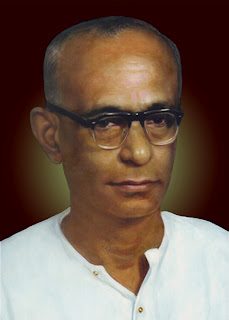
| Late Kudpi Vasudeva Shenoy |
This
is a tribute to my father Late Kudpi Vasudeva Shenoy on his 110th
Birth Anniversary, based on the article that I had written two years ago in
Kannada, part of which has been published in the book “Mangaluru Darshana” jointly
published by the DC of Dakshina Kannada, Mayor of Mangaluru City Corporation
and Chairman of MUDA.
This article covers the life and times of Kudpi Vasudeva Shenoy with inputs
from my sister Dr. Veena Isloor and my brothers Srikanth, Kamalakanth and
Radhakanth.The incidents and narrations are true to the best of my knowledge,
and the article is written without prejudice to anyone mentioned within, living
or dead.
- Kudpi Rajanikanth Shenoy
---------------------------------------------------------------------
Undivided
Dakshina Kannada District has produced great writers, journalists and
playwrights over the last century. One man was a legend of his own times,
having inculcated all those three abilities, dedicating his entire life for the
field of literature. He is none other than my father, Late Kudpi Vasudeva
Shenoy, who kindled a spark of humour in every story that he wrote, incited a
penchant for reading among the readers of his articles, in other words, he can
very well be called as “PG Wodehouse of Kannada literature”. Apart from small
booklets of 16 to 32 pages named ‘Ondaanemaale’ and his own brainchild
‘Prabhat’ weekly Kannada newspaper which he published until his last breath; he
also wrote, directed and staged many dramas that ran for 100’s of successful
shows during the Nineteen Sixties. His dedication to Kannada literature was
like a red feather in the crown of Mangaluru city. No wonder, his creativity,
his vision, his perfection, his hard work, his workmanship and his success are
fine examples not only for his generation, but also for the generations to
come.
Birth, Childhood,
Education:
Kudpi Vasudeva Shenoy’s family hailed from Kudpi or Kudupu near Mangaluru town,
later settled down in Mangaluru indulging in trading about Three Centuries ago.
Yet, the family is renowned as ‘Kudpi Shenoy family’.
On August 29 1907, a boy child was born to a couple settled in Karangalpady,
Kudpi Narasimha Shenoy and Kalyani Bai. Kudpi Vasudeva Shenoy, popularly known
as ‘Kudpi’, was the third among the children and the eldest surviving son. His
elder brother Madhava succumbed to Typhoid and he also lost his father when he
was just 12. With the help of his
maternal uncle advocate Adige Varadaraja Shenoy, he completed his schooling up to
4th Form or SSLC. He was not lucky enough to study further or
complete college education, since he had the responsibility of looking after
his mother and his younger siblings. Thus he went in search of a decent job and
was employed as proof reader in Prabhakar Press Udupi.
Though
he didn’t have college education, he was a voracious reader. He found a treasure
of books in his uncle’s house and he read them all. Thus he improved his
general knowledge and developed passion for literature. During his school
times, he was active in writing and dramas. His teacher MN Kamath was impressed
by his talents and he had presented him his fountain pen and told him, “With
this pen, write good stories, and be a famous writer!”
“My father had kept that pen intact in his safe keeping until his last breath”,
reminisces Kudpi’s daughter Dr. Veena Isloor.
Marriage, Family Life:
Kudpi
married
Ramabai,
youngest daughter of school master from Bantwal Krishna Shenoy and Radha Bai in
the year 1936. The couple had 8 children. Eldest was daughter, Dr. Veena Isloor
who studied MBBS in Christian Medical College Vellore, settled with her husband
Dr. Suresh Isloor in Shivamogga with own nursing home by name Sahyadri Hospital
since last 52 years. Kudpi always wanted his daughter to be well educated, and
the way he looked forward keenly to her return with Medical graduation is still
remembered by his younger children.
 |
| With his beloved wife Ramabai |


Among
the other 7 male children, with the untimely demise of Chandrakanth, the eldest
one in 1958, the next eldest son Shashikanth worked as Manager in Bank of
India, took Voluntary retirement, graduated in astrology with gold medal,
practicing astrology as a freelancer. Second one Srikanth studied Engineering
at KREC (present NITK), joined Syndicate Bank and served as Divisional Manager
before availing VRS and continuing further as professional consultant for
Banking finance and valuation for 17 years and has retired fully from his
profession since last 4 years. Third son Dr. Krishnakanth has settled in England as a
Psychiatrist. Fourth is Dr. Kamalakanth, who is a Dental Surgeon by profession
and also professor in Yenepoya
Dental College.
Fifth is Dr. Radhakanth, a Radiation Oncologist at present practicing in Barbados, West Indies.
I, Rajanikanth am the youngest son, have worked for Syndicate Bank for 22 years
and opted for VRS to start Multimedia profession, now a freelance media person.
Kudpi
groomed up all his children well, gave them good education, inculcated good
manners and made them fine citizen. The moral stories, anecdotes, riddles and
words of wisdom he used to quote, the guidance and encouragement he used to
give, has worked wonders in making his children successfully settle down in
life and reminisce over the good times they had with their father. Though Kudpi
didn’t accumulate wealth or buy properties, his children have maintained the
books, furniture and artifacts from his collection in immaculate condition even
today in his memory.
All
the children have inherited writing abilities from their father. They have
written articles, stories and got them published in various books, magazines,
journals and web portals. ‘Deepavali’, a short drama written by the eldest son
Chandrakanth and ‘Birbalana Jaanme’ by Shashikanth (KuSha) have been published
by Kudpi in his Ondaanemaale publications.
Following
the footsteps of my great father, I have assumed the pen name ‘Kudpi
Raj’, published my father’s books, dramas and stories in e-book format and
distributed them free. I have also written many stories, poems, dramas,
produced and directed radio plays, edited and produced youtube videos and TV
documentary and ad films, I have also made radio plays of Kudpi’s Konkani
dramas ‘Dolyaan Khelu’ and Bhangrachi Goddadi’. My mother had saved Kudpi’s
collection of books and manuscripts until her last breath in February 2014, and
now I have them in my possession and care.
 |
| With Rathnavarma Heggade of Dharmasthala in 1957 |
Soon after losing his eldest son Chandrakanth, a grief
stricken
Kudpi
was clueless about shifting his residence to some other house. Then Rathnavarma
Heggade, Dharmadhikari of Dharmasthala came to his help and he offered a big
bungalow with 8 rooms that he had constructed next to his official residence ‘Veera
Bhavana’ in the prestigious Ballal Bagh area of Mangaluru on a very nominal
rent of Rs.50/- for 4 months. After the completion of 4 months, Kudpi was ready
to vacate that house, but Rathnavarma Heggade allowed him to stay there
indefinitely, as he had dropped the idea of making that house a choultry. Thus
Kudpi continued to stay in that house for the next 16 years on a rent of
Rs.65/- per month! When the next Dharmadhikari Veerendra Heggade asked him to
vacate the house and let it for opening Law College,
Kudpi vacated the house in 1974 and moved to his son Srikanth’s newly
constructed house in Mannagudda.
 |
Our old home at Veera Bhavan, Ballal Bagh Mangalore
 |
| Our old home at Veera Bhavan, Ballal Bagh Mangalore |
|
 |
| Our old home at Veera Bhavan, Ballal Bagh Mangalore |
 |
| Our old home at Veera Bhavan, Ballal Bagh Mangalore |
 |
| Our old home at Veera Bhavan, Ballal Bagh Mangalore |
 |
| Our old home at Veera Bhavan, Ballal Bagh Mangalore |
 |
| Our old home at Veera Bhavan, Ballal Bagh Mangalore |
 |
| Our old home at Veera Bhavan, Ballal Bagh Mangalore |
 |
| Our old home at Veera Bhavan, Ballal Bagh Mangalore |
 |
| Our old home at Veera Bhavan, Ballal Bagh Mangalore |
Kudpi
not only loved his own children, he also cared for neighbourhood kids like his
own. Whenever he visited Mumbai with his work, he used to bring goodies like
peppermint, biscuits, pen, pencil, eraser, toys and games and also distributed
them among the neighbourhood kids and felt contented to see them happy. When my sister was senior house surgeon in Mysore in 1963, he
engaged Jabbar’s taxi and took me and our neighbour Mahaveer along with. When
Mahaveer threw up while traveling up the Madikeri Ghat, Kudpi had taken good
care of him, cleaned him near Jodupala water stream and treated him like his
own child and made him sleep comfortably on his lap!
Kudpi
never looked back or calculated money when it came to running the home. He was
a good philosopher and guide, a father figure to his naive wife Ramabai, who
was almost half his age during their wedding. He taught her the significance of
maintaining the home clean and neat, groom up the children, cook good food and
also help their neighbours in case of need. Whenever she wanted entertainment,
he arranged for a taxi to drop and pick her from the cinema hall and also
provided an escort to take care of her. Though Kudpi never stepped into the
kitchen or cooked anything in his life, he used to guess the ingredients and
methods of cooking rare dishes that he used to taste in restaurants and guide
his wife to make them exactly the way he wanted them! In the mid Sixties when
cooking gas was first introduced by Esso Gas in Mangaluru, he was one of the
few who got a connection for home, so that his wife could manage without the
hassle of lighting kerosene or charcoal stove.
In
1959 he purchased a new National Ekco 8 Band Radio for the entertainment of his
family members. He also purchased a Hercules bicycle for his son Shashikanth to
reach Government College on time, during his BCom studies.
My brother Kamalakanth reminisces, “In the year 1964, Kasturi Bar Soap had
organized a competition. Prize winners were announced in the papers and the
final round was in Bangalore.
My father was one of the judges and father took me by bus along with him to Bangalore, so that I can also
see the city and enjoy the trip. On our
way back, we took the Dakota flight from Bangalore
to Mangalore. That was my first experience of traveling by air. In my 7th
standard, not many had seen a plane as yet! That flight was most memorable, and
that shows my father’s concern for the comfort and joy of his children!”
Kudpi’s office was in Car Street, opposite Balaji Cinema.
During
festivals,
Kudpi used to facilitate women and children to sit in his office and watch the
festivity through the window overlooking Car Street. He also used to arrange for
snacks and beverages from Taj Mahal and Komal Vilasa for them. Since mango was
dear to all in the family, during summer he used to purchase variety of mangoes
from one Fakir Byari by the baskets, bring them home and keep them on hay for
ripening. A rare variety by name ‘Kempu Size’ used to be acquired in full lot
every year from Fakir Byari!
 |
| With Ramabai at Ootacamund |
My mother Ramabai was a loyal wife to Kudpi. She used to
prepare all his favourite dishes whenever he demanded. She also used to prepare
4 cups of tea and store it in a flask for him to consume during late hours when
he sat down to write on the veranda. One night as Kudpi was writing something,
he smelled something burning and to his worse fears, the back room of the house
was on fire! A domestic helper woman had carelessly dumped cinder along with
ash from the bathroom kiln in a cane basket, that caught fire and the fire
spread to the woodwork of the roof! Kudpi hurriedly woke up Ramabai and her
nephew Damodar who was staying in our home for his graduation. The three of
them worked together, drew water from the well and put off the fire without
much ado. Next morning, as D. Puttaswamy the neighbour asked about burnt smell,
Kudpi hushed up giving reasons that it was just the cane basket that caught the
fire and emanated the burnt smell. He also ensured that the wife and children
maintained secrecy about it and also got the burnt wooden beams replaced
without much ado!
 |
| With a dignitary and D. Puttaswamy(Right) in Dharmasthala |
Though he lived in a mansion like house on a rent of just Rs.65/- per
month, he used to spend a lot for maintaining it. He used to get it painted
every three years and also get essential repairs done
periodically without thinking twice about the expenses. I still remember that
Harshendra Kumar, younger brother of Veerendra Heggade had specially mentioned
about my father and appreciated his concern for maintenance of the house,
during the inauguration of Syndicate Bank branch in that house in 1998.
Personality, Routine:
5
feet 6 inches tall, small build, longish face, wheat complexion, always wore
clean white Muslin Dhoti and Cream colour Kurta with fine cotton material from
Shurrock Mills, and a Gandhi cap over the head, dignified look and gait,
straight talk and action, movement as slick as mercury, slightly short
tempered, in other words a no nonsense man; these are the qualities that
highlighted the personality of Kudpi.


He always followed Gandhian and Buddhist philosophy. He wore Khaddar for
decades before and after the Independence.
He always believed in introspection before correcting others. I have never seen
him beat any of us children when we committed mistakes or played mischief. At the most he might have scolded us and told
us to leave the house, but the very next moment he would call us, make us sit
by his side and explain the importance of good and refined manners, need for
hard work to achieve our goals and a distant vision to be successful in life.
His inimitable style of narrating humour with a serious look and a smile
following the narration was not easy for most of his contemporaries to imitate.
He never looked down upon the poor and the needy. He always helped them in time
of need monetarily and morally. He had the rare quality of adjusting to different
types of people irrespective of their social and financial status, if not their
knowledge level. Cleanliness, simplicity, honesty, perfection, command over the
three main languages English, Kannada and Konkani, proper usage of grammar,
variety in his write-up, were his hallmark and thus he became very popular as a
writer, journalist during his times.
Kudpi
was also very meticulous about his food habits. He maintained a steady 133 Pounds
(60 Kgs) body weight always. He rarely fell ill, and as far as I remember,
during my 20 years with him, I saw him falling ill only twice or thrice. His
tolerance to pain and suffering was a puzzle even to his close friend, our
family physician Dr, B. R. Hegde! He had the knowledge of medicine and he
mostly took self medication in times of minor ailments. When our sister Veena
was a school going child and she had Typhoid after the Second World War, she
had bleak chances of surviving. Those days most of the doctors would give some
concoction or home remedy to such deadly ailments and ask the family members to
pray for the recovery of the patient! In such trauma, Dr. B.R. Hegde said,
“Kudpi there is a new wonder drug in the market by name Chloromycetin, which
can cure typhoid. Why not try that? Two capsules cost Rs.45/-. She should be
administered 3 capsules a day for 5 days and she may recover. Why don’t we take
a chance?”
Those days, for 45 Rupees a family of 10 people could sustain for a month!
Kudpi never looked back and he gave his consent. Thus our sister recovered from
Typhoid and today she is 79 year old practicing doctor who has cured thousands
of women and children with her treatment and care!
His daily routine started with waking up at sharp 6:00am,
after the morning rituals, he would take a walk around the house and check if
things were alright. Then he would dust the furniture, polish his favourite
porcelain ‘Shiva Bust’, light a ‘Punugu Ambar’ or ‘Sugandha Shringar’
agarbatti, then switch on the radio and tune in Radio Ceylon for old
film songs at 7:45am. Then he used to sit on the floor with his shaving kit and
start shaving as he nodded his head to K.L.Saigal songs that broadcast at
exactly 7:57am, I would run and reach the radio room to sit by his side and
watch him make funny faces at me, nod his head to Saigal’s song and make me
laugh! Wonderful days indeed!
Then
he would have a cold shower with his favourite Malabar Glory, Cinthol or Mysore
Sandal Soap, sip a cup of tea and smoke a cigarette as he read the daily
Kannada and English newspapers sitting comfortably in his easy chair. Exactly
at 9:15am, he used to have his breakfast, change his dress and walk to the
nearest bus stop in Lalbagh carrying his office bag and wait for the route no.8
bus that ran from Karnataka Polytechnic to Hampankatta via Car Street. If he
missed that bus, he never looked back and he would walk all the way to Car Street to reach
his office. At times when he felt that he was late, he would catch an
autorickshaw and reach his office.
 |
| With Manel Srinivas Nayak, MLA at the Vidhan Soudha Bangalore |
His close friends Manel Srinivas Nayak(MLA) and Manel Krishna Nayak of MA Krishna Nayak
& Co or his cousin Kudpi Vishwanath R Shenoy of Om Mahal sometimes dropped
him to office or back home. After spending the morning hours in office, he used
to come home at 2:00pm for lunch, take a short nap, have a cup of tea at 3:30
and return to office at 4:00pm. He would work until late evening and close his
office at around 8:00pm, head straight for Studio Balco owned by his best
friend S.R. Balgopal, meet like minded friends including B. V. Baliga there and
spend over an hour in a discussion always leading to riot of fun, humour and
laughter, and by the time he returned home for dinner, it would be 9:30 or
10:00pm.
His daily routine does not end there! He spent time until late hours reading
books and writing stories, dramas and articles for his paper past 2:00am. No
signs of sleeping a wink, for enough tea would be ready in a flask on one side,
thanks to his faithful life partner Rama Bai, and his daily dose of beedies and
cigarettes along with an ash tray on the other, for inspiration and to stay
alert!
This
late night habit of his went to extremes at times, and one early morning at
5:00am, our neighbour D. Puttaswamy saw the light in the verandah still on, and
he curiously asked, “Did you wake up early, Mr. Kudpi?” My father coolly told
him that he never slept a wink, and he didn’t even realize about it, since he
was deeply engrossed in writing something!
Because
of his straight forward nature and denial to obligations, he refused to use his
influence with the then Education Minister C. Subrahmanyam of Madras Province
to get easy medical seat for his daughter Veena at Vellore. She later got it on merit. Kudpi
never tried for back door entry anytime in his life!
My
brother Kamalakanth has a different story to share. He used
to look after father’s press and office from Sixth standard until he completed
PUC. He also used to help father according to his abilities. One day father had
to go somewhere, and he told Kamalakanth to stay until he returned. So,
Kamalakanth just sat there, waiting for father to return. Clock turned Eight,
Eight Thirty, Nine, Nine Thirty. There was no sign of father returning!
Kamalakanth didn’t take liberties, fearing that father might scold him if he
moved out of his office. Finally he received father’s phone call at 10:00pm and
asked him what he was doing until late hours in the office! Then Kamalakanth
sighed in relief, gained courage, left the office and went home. Knowing
father’s strict nature, all the children obeyed as he instructed and never went
against his orders!
I have memories to share from my primary school times. On February 22nd
1966, when the annual Spring Festival called ‘Vasantotsava’ was celebrated,
father gave 8 Annas(50 Paise) each to me and my elder Radhakanth to spend on refreshments
at the make shift canteen they had arranged in the school. Radhakanth spent
that amount over some snacks and lemon juice, while I was two minded about
spending my pocket money. I also had the urge to buy something for home which
all can share and eat. On my way back from school in the night, my classmates
Ravi Kumar and Naveen Kini suggested many things. The last suggestion from
Naveen was to buy whole roasted Peanuts at a Bakery near our home. For 50 Paise
I got one ‘Ser’ peanuts and took it home, handed it over to mother. Mother was
surprised and she asked me why I spent my pocket money on peanuts while I was
supposed to have refreshments at the canteen! I naively replied that no one had
ever brought such a heap of peanuts in our home, and I wanted to bring and
share that with everyone. Mother complained to father and father scolded me and
ordered me to return the peanuts immediately and get back the 50 paise from the
bakery! He added that he can not tolerate such indiscipline. I was astonished
that my good deed was not recognized by anyone, and father scolded me instead
of appreciating my deed! I pleaded that I shall not repeat the mistake again.
After many years I could understand that he actually expected me to spend my pocket
money the way I was supposed to, and not take liberties.
Many
people
visited
our home to see Kudpi. Mostly on Sundays when he was in the bathroom taking
showers, I would hurriedly call him aloud, saying someone was waiting to meet
him. Then he would shout back and say “Let them wait for a while. They have
come for their work, not to help me. I am half way through bathing. I can not
come out right now. Ask them to sit and wait for me!”
Religious views, Rational
approach:
Though Kudpi believed in existence of god and followed religious rites because
he was born in an orthodox GSB family, he never gave scope for blind belief. I
don’t remember having seen him enter the temple any day and perform pooja. Though
he had his office in Car Street
close to the Venkatramana
Temple, in spite of
writing at length about Gowda Saraswat Brahmin community, his daily gesture was
just folding his hands and bowing his head while passing by the temple. He also
avoided the annual Rathotsava feast at the temple but his friend Harekal Ramachandra
Pai (Ramanna) used to bring him the temple feast packed in tiffin carrier and
he relished it in his office.
Sometimes when a seer of any popular mutt visited Mangaluru,
he used to go along with his cousin Kudpi Vishwanath. R. Shenoy and receive the
seer at the airport and drop them to a local temple or mutt. He also used to
attend the sermons by such seers in professional interest and publish feature report
in his weekly newspaper Prabhat. He also used to perform the annual
Krishnashtami pooja at home in the presence of Pandit Venkatesh Acharya of Acharya Mutt Car Street.
Whenever Acharya chanted some mantra or shloka that was not clearly understood,
Kudpi used to stop him and ask the full meaning of that shloka in Konkani. He
was a non believer in astrology and palmistry. He was also against unnecessary
and wasteful expenditure on weddings and functions. He celebrated his only
daughter Veena’s wedding without much glitter, inviting a limited crowd of only
nears and dears but arranged for sumptuous feast during the wedding, as he was
a connoisseur of good food. He had celebrated all his sons’ Brahmopadesham at
home in the presence of only family members.
I strongly assume his publishing weekly astrology and articles
on
temples,
gods, festivals, mutts and religious heads was in the larger interest of the
readers and not out of his own belief. I would like to point out two incidences
to support my assumptions.
In
the year 1976, when the noted Rationalist Dr. Abraham Kovoor came to Mangaluru
to address a meeting at the Don Bosco Hall, I was a member of the South Kanara
Rationalist Association founded by Narendra Nayak, and I
was also a volunteer at the meet. Yet, I didn’t inform father about my
activities, about the function, didn’t even give him the invite to the
function, thinking that he may discourage me or tell me not to indulge in such
activities. I was surprised when he called me the next morning, smiled and
asked me all about the function! He also published the news in the very next
issue of his paper.
In
another incident, M. Subrayan was the official astrologer writing weekly
astrology column in Prabhat paper. Subrayan was ill for over a month and then
Kudpi was in a dilemma about how to publish it in the absence of Subrayan.
Suddenly an idea flashed to his mind and he dished out two year old issues of
Prabhat and copied the same predictions that were printed in those issues and
sent them for printing! He has described pretty well about the fraud that
happens in the name of astrology, in a satirical story in his Ondaanemaale
publication by name ‘Jataka Pathana’.
Journalism:
After
working
for two years in Prabhakar Press, Kudpi joined Kanteerava
paper as co-editor. He also worked as co-editor of ‘Rashtrabandhu’ and
‘Swadeshabhimaani’, thus contributed in his own way for the freedom movement.
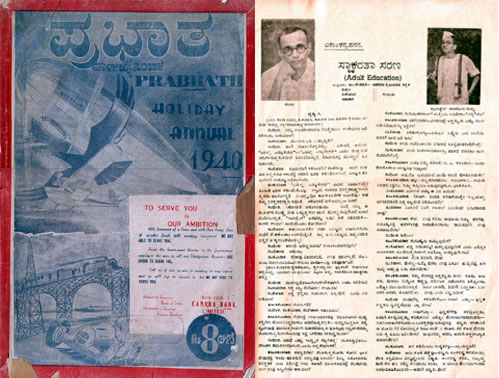
In 1935 he established his own newspaper ‘Prabhat’, printed and published it at
the City Press and reached the summit of success. Prabhat office functioned on
the upstairs of the premises by the corner of Car Street opposite Balaji Talkies for 42
years until he breathed his last. Prabhat paper was a decent publication circulated
throughout the West Coast reputed for value based content. He never gave scope
for yellow journalism or pornography. Many noted writers contributed articles
in Prabhat. Kudpi also covered latest news from Bombay film world and published that with
colour plates in special issues of Prabhat, thus gave a glitter of
modernization to Kannada journalism during those days in the Forties and the
Fifties.


 |
His teacher and mentor MN Kamath's article in Prabhat
With VS Kudva and others at the Inauguration of
Press Club Mangalore on 27.5.1965 |
My
brother Srikanth knows in and out about Kudpi’s struggle to establish the press
and shift it to different places over the years. In the year 1940, Kudpi
started a public limited company named Prabhat Printers Limited and he was the
Managing Director. He printed not only Prabhat paper and his other publications
there; he also undertook printing of other publications such as Manmohan
Kamath’s ‘Sandhyadeepa’ and V.J.P. Saldanha’s ‘Kannadavani’ papers for some
time in the Sixties. The press functioned in a house in Sundar Rao’s Compound
opposite Mission High School until 1967. Though he
shifted it to a small building on Azizuddin
Road opposite City Press, suddenly in 1969 the
owner of that building sold it to a new party and that new owners evicted the
press overnight in pouring rain. Kudpi underwent heavy loss due to printing
machines, papers and types getting washed in the heavy monsoon showers, but he
never lost courage. His closest friend S.R. Balgopal came to his help and he
joined as a director and saved Kudpi from the trouble of finding a new shed or
godown. They shifted the belongings to a godown and then took a land on lease
behind Besant College on MG Road. There they built a shed and
continued printing Prabhat paper there until 1977. Mr. Balgopal didn’t think
twice before investing in the company as a director, rather he acted as a
saviour because his close friend was in an almost devastated condition!
Kudpi’s
sons assisted him during school/college vacation by working in his office and
press, proof reading, book binding, pinning etc. My elder brothers still recall
having earned some pocket money as well as appreciation from father for the
work they did those days in the Fifties and Sixties. In the mid Fifties, my
first three brothers Chandrakanth, Shashikanth and Srikanth came out with a
hand written illustrated children’s magazine in 200 page note books, resembling
Chandamama and Balamitra. They called it ‘Jnanodaya’ and circulated them among
their neighbourhood boys and earned some money. They published such 10 issues
in three years, an achievement perhaps unparalleled by any boys of their age
then!
Special
issues of Prabhat exceeded 200 pages, carrying a feast of colourful feature
articles, stories, dramas and poems. Not just film world, they highlighted
achievers with pictures, write up and pictures on Dharmasthala, also extensive
coverage on commercial activities of Mangaluru. Thus Prabhat had international
standards when it came to coverage and looks! Kudpi was a close ally of
Manjayya Heggade and Rathnavarma Heggade of Dharmasthala. He was in charge of the
Exhibition held in 1957 at Dharmasthala during the ‘25th Sarva
Dharma Sammelana’, he managed it very well and also published a souvenir to
commemorate the event. He printed and distributed colour photos of the Manjunatha Temple and the various monuments of
Dharmasthala with the help of Balco Studio.


 |
| Coloured photos of various monuments in Dharmasthala, 1957 |
V.S.
Kudva
recognized
and
highly
commended the journalistic abilities within Kudpi and he appointed Kudpi as the
founder editor of ‘Navabharata’ which he founded in 1941. Navabharata was the
most circulated Kannada daily in coastal Karnataka during those days. Kudpi
also suggested the character and the name ‘Shinganna’ to Raghu (Kanneppadi
Ramakrishna), the cartoonist of Navabharata.
 |
| Navabharata Kannada Daily |
Kudpi
also established a weekly paper exclusively for women by name ‘Suvasini’.
Varija Devi and Mohini Devi were the editors of that paper. Thus Kudpi openly
supported and empowered women during olden days! He also published many
articles by women in Prabhat.
In
‘Basiga’, the souvenir of Dakshina Kamnnada Jilla Sahitya Sammelana held at
Karkala, Kudpi has written in detail about the growth of journalism, in an
article ‘Journalism in Dakshina Kannada District’. Those trained by Kudpi in
his Prabhat paper and press started their own and prospered. B.V. Baliga was a
close ally of Kudpi. He not only wrote articles in Prabhat, he started his
Konkani magazine ‘Panchkadaayi’ under guidance from Kudpi. Kudpi taught him the
right usage of Konkani in journalism and encouraged him to run the magazine
smoothly.

As
circulation of his brainchild ‘Prabhat’ started diminishing by late Sixties,
Kudpi started to face financial crisis, but he never accepted defeat. He
printed and published it until his last breath. He never ran it just to make a
profit. He wanted good Kannada articles and news reach Kannadigas in Mumbai,
also encouraged many young writers to come into limelight. Since Mumbai had
more readers of Prabhat, every year during Republic Day, Independence Day,
Dasara and Deepavali, he came out with special edition of Prabhat. With the income
from advertisements, he looked well after the family members’ needs. Though he
printed and sent just 224 issues of Prabhat by post durng the last few years,
he never lost zest or courage. He never showed disappointment. Though the elder
four children had settled well by the time he became older, he never sought
their help or depend on them for his expenses. He raised his income from advertisement
funding for Prabhat.
-------------------------------------------------------------------------------------------------------------------------------
Kannada scholar Dr. Vamana Nandavara has written essay about Kudpi’s journalism.
-------------------------------------------------------------------------------------------------------------------------------
Stories, Essays, Literature:
Since the day he started Prabhat weekly until the Nineteen Sixties, Kudpi wrote
hundreds of humour stories, anecdotes and essays. ‘Jeevanada Sogasu’ written in
1935 was his first article. He also compiled the articles that he wrote in
Prabhat weekly from time to time and published two such compilations with short
stories, namely ‘Meere Mattu Naanu’, ‘Japan Belaku mattu Itara Kathegalu’ in
1948. In 1949 he published the essays ‘Malegaalada Sapnagalu’ and
‘Aayaasavillada Ogatugalu’ in the form of books.
‘Meera
Mattu Naanu’ has 15 humour writeups that revolve around a cool husband and his
restless wife narrating the funny incidents that happen in their daily life.
The hero in those stories is always positive in his thoughts and actions with high
tolerance for questions and utmost patience to answer them. Meera is a modern
woman with tomboyish nature, nagging, short tempered and adamant. The dialogues
between them can incite a roar of laughter among the readers, imagining the
scenes that happen in a typical local family, their arguments, blow hot and
blow cold. There is never a day when Meera and her husband do not argue and fight.
There is no evidence, that following the fight they stop talking with one
another and get separated. Everything happens within a day and ends overnight after
which, both get rejuvenated for a new fight!
‘Japan
Belaku Mattu Itara Kathegalu’ has 16 humour stories. One can find similarities
between the characters in these stories and Sir P.G. Wodehouse’s stories. Yet, these stories highlight the lifestyle,
culture and traditions of our town, if not word play and witty dialogues, which
Kudpi has cleverly adapted in them.
‘Kasada
Dabbigalu’ is a compilation of 24 essays. Every character and the situation if
not the place, seem rather realistic and not give scope to believe that they
are fictitious. One can very well sense the strong whiff of contemporary Kannada
literature at its best, if not sharp witted crisp dialogues in these essays.

Kudpi
has published 348 Ondaanemaale books from 1954 until
the1960’s. The very first book published in the
Ondaanemaale series is ‘Keppateraaya’ by Kudpi’s teacher M.N. Kamath. Last one
is ‘Angulimala’ by K. Bhoja Poojary. Those noted writers who contributed to
Ondaanemaale include M.N. Kamath, Rashtrakavi M. Govinda Pai, B. Shankara Bhat,
B.M. Sharma, M. Subrayan, A. V. Mayya, Balkur Subraya Adiga, Ammembal
Ananthayya Navada, Rasika Puttige, Navagiri Nanda, Ambatanaya Mudradi, B.
Padmanabha Somayaji, T. Chandraraja Shetty Siddakatte, ‘Vichitra’ Aetadka, Dr.
S. P. Bhat, Dr. T. P. Bhat, L.S. Nayak, S. L. Sharma Kasargod, Padaaru Mahabaleshwara
Bhat, K. N. Bhat Shiradipal, B. Eshwarayya, Vaidyaguru M. R. Bhat, D.
Puttaswamy, K. Venkatarayacharya Surathkal, Gundmi Mahabala Bhat, Venkataraja
Puninchattaaya, K. S. Karanth, Naralamatha Anantha Upadhyaya and many others.
Kudpi also gave shelter to many upcoming young writers.
Among the books Kudpi authored in Ondaanemaale, there are
short stories, moral stories, humour, if not dramas. His most selling books
were ‘Panditana Piteelu Mattu Itara Kathegalu’, ‘Jatakapathana Mattu Itara
Kathegalu’, ‘Ee Yugada Thenkaara Kumara’, ‘Saahasada Kathegalu’ and ‘Huchhu
Kathegalu’. Apart from short stories, he also wrote short plays that became
famous, such as ‘Satyavanta Baabi’, ‘Baabige Baasinga’, ‘Naareeshwararu’, and
‘Chunaavane Arthaat Banaavane’. Then there were books on general knowledge and
travelogues including ‘Aesopana Neeti Kathegalu’, ‘Vinoda Vihaara’, ‘Pradhaanaamaatya
Pandit Jawaharlal Nehru’, ‘Namma Desha’, ‘Namma Kannada Naadu’, ‘Sarvajnana
Vachanagalu’, ‘Sri Kanakadaasara Bhajanaageetegalu” and of course the
unabridged ‘Srimad Bhagavadgite’ sold for One Anna, which he published with
financial sponsorship from D. Puttaswamy and Dharmasthala Manjayya heggade’s
daughter Vimalamma Ballal.
I still recall how we brothers joined hands and packed 50
books each of Ondaanemaale in bundles and arranged them in shelves in
chronological order at our home ‘Veera Bhavan’ in Ballal Bagh within three days,
when the press was shifted to new premises in 1967.
Kudpi’s
friend
Harekal
Venkatramana Pai took possession of the entire collection of Ondaanemaale from
Prabhat Office and dumped them at his home, few years after the passing away of
Kudpi. He patiently wiped them clean and sold some copies at Kannada Sahitya
Sammelans for One Rupee each.
Ondaanemaale was talk of the town those
days,
and
school, college students used to wait and enquire about new issues of
Ondaanemaale at Venkat Rao’s Nityananda Granthalaya, B.
Damodar Baliga & Sons and Bhoja Rao And Sons, if not at Prabhat Office.
Ondaanemaale was like encyclopedia for the poor with hunger for Kannada
literature and general knowledge. Some of the renowned scholars reminisce over
their difficult days, when they collected small change with difficulty and
purchased Ondaanemaale to satiate their hunger for literature! Ondaanemaale was
like red feather in Kudpi’s cap of achievement.
-----------------------------------------------------------------------------------------------------------------------------
Dr.
Sabiha Bhoomigowda, Vice Chancellor of Akkamahadevi Women’s University has
written in detail with fair analysis, about Kudpi’s literary achievements,
stage activities and Ondaanemaale, in a book published by the Kanthavara
Kannada Sangha named ‘Ondaanemaaleya Saahasi Kudpi Vasudeva Shenoy’.
 |
| PC: https://www.mangaloreuniversity.ac.in/dr-sabiha |
-------------------------------------------------------------------------------------------------------------------------------
Stage and Drama:
Kudpi was deeply involved with stage and dramas. He was adept at writing a new
drama overnight. Discerning viewers who demand top notch humour mostly had the
opportunity to watch and appreciate his dramas in the Nineteen Sixties. Kudpi
had the knack to create the right characters and find the right actors to do
full justice to those roles. ‘Purusha Vadhu’ written in 1936 was his first
published drama. ‘Baabige Baasinga’, ‘Satyavanta Baabi’ and ‘Naareeshwararu’
published in Ondaanemaale in the Fifties have not only received acclaim from
the readers, they also have been enacted on stage at many schools and colleges.
‘Naavu Saahukaara Kuladavaru’ is a mirror that reflects the double standards,
arrogance and megalomania of the rich class belonging to the older times. Kudpi
has rightly exposed the true colours of politicians in ‘Chunaavane Arthaat
Banaavane’, in which one can see how election campaign of useless candidates is
highlighted, how sycophants run behind them and misguide them, also the agents
and middlemen who play double game and make hay when the sun shines. Perhaps
what we can deem as its sequel, ‘Saitaananodane Karaaru’ has not been printed
as yet, but e-book of the same has been released. If the theme of the two
dramas is relevant even today, one can very well understand the far sightedness
of Kudpi about common man!
In
1955 he wrote an essay named ‘Namma Rangabhoomi’ which was like a guide for
drama artists and directors. Every aspect of drama has been well discussed by
Kudpi in that essay. It gave a modern touch to the stage activities of early
times, we can say.
In the year 1960 when All India Kannada Sammelan was held in Manipal, Kudpi was
approached by the conveners to write and stage a drama to add spice to the
event. Thus he wrote “Sanyasi Gongadi”, a comedy play and staged it with his
artist friends. When a swami entered the audience with his side kicks hailing
him, entire audience was stupefied, stood up and paid respect to the swami,
thinking that he was real! Then when the swami reached the stage and the drama
continued, the audience realized that he was part of the drama! That’s how
innovative Kudpi was, and shows his expertise showing variety with his
experiments on stage.
 |
| 'Sanyasi Gongadi' artistes 1960 |
 |
| Kala Bhavana office bearers with noted Kannada scholar A. Na. Kra. |


After Kudpi’s passing away, his friend Late Krishnagopal of
Mahaveer Press started work on printing Sanyasi Gongadi drama book, but he
could not complete it more than 30 percent. Then in the year 1996, my mother
Rama Bai took interest, got it fully printed and published. Kudpi translated
Sanyasi Gongadi into Konkani in 1970 and named it ‘Bhangraachi Goddadi’. Yet
another Konkani drama ‘Dolyaan Khelu’ was also staged successfully at many
places. Karnataka
Konkani Sahitya
Academy has published
those two Konkani dramas in one volume in the year 2014. I have produced and
published radio plays of those two dramas with the help of Konkani Mitra
Balaga, my friends who are amateur artists. The dramas were also broadcast by
Radio Sarang community FM station. Apart from those two dramas, I have got
Kudpi’s manuscripts of ‘Saitananondige Karaaru’ and ‘Vartaka Vilasa’ typed and
preserved as soft copies or E-books along with earlier printed and published
dramas during Kudpi’s birth centenary in year 2007. I have also distributed
free copies of those E-books to interested people.
In
the mid Nineteen Sixties, Kudpi was secretary of Kala Bhavana, a trust that
used to hold week long drama festivals every year. He was also instrumental in
holding stage camps for amateurs.
Kudpi apart from writing and staging his own plays has also translated and
staged the Matrati play ‘Ekach Pyala’ in Kannada with the title ‘Onde
Gutuku’. We three brothers Shashikanth,
Kamalakanth and I used to assist him in writing manuscript copies of some of
his dramas in the late Sixties and the early Seventies.
Some of the friends who have acted in Kudpi’s dramas are SR Balgopal,
Krishnagopal, Ramananda Choorya, Manel Krishna Nayak, BV Baliga, Mohan Rao,
Basti Narayana Shenoy and Srinivas Bhat. Those days, they used to act and show
dramas for free. They didn’t chased money, rather acted out of academic
interest and to expose their creativity. Kudpi also wrote clean script without
vulgarity or double meaning in any of his dramas.
Sense of humour, Humanity, Generosity:
Kudpi had a huge fan following because of the high sense humour he had. At
any function or meeting, if Kudpi was to speak, there would be a huge crowd
waiting for a roaring overflow of mirth.
The way he narrated any funny incident with a serious expression on his
face was an art not possessed by many! He never showed self praise or forced
anyone to follow him.
Havanje Venkatesh Shenoy a friend working for City Press was residing in Ballal
Bagh area. He talked, walked and worked like express bus according to Kudpi’s
observations! One fine morning Kudpi was waiting for the bus for office.
Venkatesh Shenoy appeared from a distance. As he neared, Kudpi suddenly jumped
and blocked his way and held him by the hand, asking him why he was in such a
hurry! Mr Shenoy pleaded to let him go.
Kudpi said “What’s the urgency maaraaya! Stay a while, let’s talk for a while!”
Shenoy pleaded him again and again and finally Kudpi let him go!
My colleague in Syndicate Bank Huruli Ramachandra Rao, son of ‘Kanteerava’
editor Late Huruli Bheema Rao has another story to narrate.
One day Huruli visited Prabhat office along with his son, small boy Ramachandra.
Kudpi saw Ramachandra and askd Huruli “How many loads of soil has this boy
carried uphill?” meaning, how far he had studied! Mr. Rao also added that when
his father and my father met, it was an explosive meeting full of wit and
humour!
Kudpi’s sense of humour also worked in trying to instill good behaviour among
us boys. Here, you may recognize the spontaneous choice of dialog with a whiff
of sarcasm and wisdom in my father’s query, and also escapism in my reply!
We had shifted from Ballal Bagh to a house on rent at Ashok Nagar in July 1974
for three months. That house had attached bathroom. One afternoon my father
came home for lunch and he headed for the toilet. When he came out, he had a
matchbox in his hand. He came straight to me and handed over the matchbox to
me, saying “Take this. You had left it in the bathroom.”
I was shocked and annoyed that he came to know about me secretly smoking
cigarettes! Yet I was cool, and I said “It is not mine. Why do I need a
matchbox?”
”Maybe there was power failure and you wanted it for lighting a candle.”
”Power failure and lighting during day time?” I showed surprise.
Immediately Kamalakanth came to my rescue and he said “Father, I think the
matchbox is yours, and you had forgotten to pick it earlier!”
Then father had no doubt, that both of us were hidden smokers and one thief
tried to save other!
He slyly smiled and replied, “You maybe right. At this age of mine, I naturally
tend to forget things!”
My brother Radhakanth reminisces that during his school times, he stood 3rd
in his class, while two other boys Suyajna Joshi and Jayavardhana came first
and second always. When he told that to father, father asked him, “Could it be
possible that Jayavardhana’s rival’s name is Apajayapatana?” Radhakanth is all
smiles, when he narrates that incidence.
He had compassion for financially, physically and mentally challenged people in
the walk of life. He encouraged them into doing jobs and also paid them
handsome wages. There was an ex-military jawan by name Sankappa who was hit by
a shell during war and had mental disability, which stopped public from
employing him. Sankappa used to roam around the Ballal Bagh area, shouting
swear words aloud, often throwing stoned at those who teased him. Kudpi called
him from time to time and gave him the job of cleaning the garden. He not only
paid him decent wages, but also arranged for sumptuous meal at home for him
after the work.
Vamayya was a physically handicapped man with one limp arm. One weekend in the
early Seventies, Vamayya was employed by Kudpi to do some chores. Vamayya was
very slow in his work compared to normal workers, but Kudpi paid him full
wages, also gave him three meals and coffee, and kept him happy. When any
neighbour was in need of financial assistance for children’s’ education or for
medical expenses, Kudpi immediately used to instruct Ramabai to give them small
loans and not to embarrass them by insisting on repayment even when they were
not able to repay the money on time.
Regarding Kudpi’s concern for hard working people, I must tell the story of
Bantwal Vasudeva Shenoy, a retired school master who ran a small shop in Ballal
Bagh selling general items. Father used to send me to Mr. Shenoy’s shop to get
his brand of cigarette No. 10, which cost 12 paise per pack.
One day, as usual I brought a pack of cigarette, father examined that and told
me “Immediately return this and get No. 10. He has given Gold Flake by
mistake!”
Vasudeva Shenoy was obviously confused with the two brands of cigarettes,
because they both had yellow coloured packs.
I was surprised that father was not happy about getting cigarettes that cost
actually twice the cost of No. 10! When I suggested him about gaining, he was
furious, and he shouted, “Go immediately and exchange it. Never have such greed
and mean thoughts in your mind. An honest hard working man is losing money and
we should be honest enough to see that he does not incur loss at our cost!
Hobbies:
Having performed three major roles in life such as a successful journalist,
writer and playwright, Kudpi had many hobbies. Most important one was his
inclination towards Hindustani Classical music. He was fond of playing flute
and harmonium. Whenever sangeet kacheris were arranged in Mangalore during his
hey days, he never missed any. He admired Hindustani maestros such as Bala
Gandharva, Bade Ghulam Ali Khan, Bismillah Khan, Abdul Kareem Khan, Pannalal
Ghosh, Bhimsen Joshi and other contemporaries. He had good rapport with his
childhood friend Harekal Ramachandra Pai (Ramanna) who used to host Hindustani
Kacheris at his house. I recall that my father used to mention about Pandit
Bhimsen Joshi having stayed at Harekal Ramanna’s house for months, before he became
a maestro. Father used to take me along with, to Hindi Prachar Samithi where
gaayan kacheris took place from time to time. I also remember having slept on
his lap during couple of such kacheris that went on until late nights in the
mid Nineteen Sixties! I think he wanted to inculcate good taste for Hindustani
Classical music among his children.
 |
| With friends in the Nineteen Thirties |
 |
| With his close friends - LS Nayak on the left, Harekal Ramanna in the center |
Apart from Hindustani Classical, he also appreciated old Hindi film songs by K.
L. Saigal, C. H. Atma and Pankaj Mullick. It was fun watching him nod his head
to the melodies that played on Radio Ceylon early in the morning. He was
listening to Marati song form Sangeet Maanaapmaan on All India Radio Bombay
regularly.
Kudpi had a penchant for photography and art. He possessed a second hand Kodak
Brownie camera that he had purchased in Bombay,
with which he captured innocent and natural poses of women and children. He
used to get those photos developed at his friend Balgopal’s Balco Studio and
get them framed at Bhat’s Photo Frame Shop below his office in Car Street, hang
them on the walls of the verandah and hall within our home.
 |
| Indian ink sketch of Kamalakanth |
He was a good artist. He drew sketches with Indian ink and published them in
his newspaper and other publications. The best one was perhaps a sketch of my
brother Kamalakanth when he was a small baby that he drew for the Ondaanemaale
book ‘Kumara’.
His liking for Hollywood movies made him watch
‘Frankenstein’ by Boris Karloff many times. He also liked Charlie Chaplin
movies and Hindi films by Sohrab Modi, Mehboob Khan, V. Shantaram, K. L.
Saigal, Sandhya, Nadia, Suraiya and others. Though he knew all the cinema house
owners in Mangalore those days, being a self made man, he never accepted free
pass. He would rather purchase tickets paying the entertainment fee which
worked out at less than 50% of the total charges, and facilitate his family
members to watch some classic films of yesteryear.
He was a voracious reader, and he had a wide collection of a variety of books
and magazines in his collection. Apart from receiving Kannada books from
authors for the courtesy of review in Prabhat paper, he also used to buy second
hand books from Bangalore and Bombay, get them leather bound in his press with
golden letters engraved in them. He had two big book cases full of English and
Kannada books, most of which are now in my possession. He admired works of
authors par excellence such as Arthur Conan Doyle, Anton Chekov, Saumerset
Maugham, Guy De Maupassant, O. Henry, Leo Tolstoy, Maxim Gorky, Charles
Dickens, Mark Twain, Jane Austen and likes. He had the full collection of Sir
PG Wodehouse, who was his most favourite humour writer. Most of those books
were leather bound and are still in good condition.
 |
| With A Na Kra |
 |
|
|
 |
| With Dr Shivarama Karanth, noted Kannada scholar and Yakshagana exponent |
Of the Kannada writers, he had interaction with A. Na. Kra., Da. Raa. Bendre,
Shivarama Karantha, Manjeshwar Govinda Pai, P. K. Narayana, S. V. Parameshwara
Bhatta, H. L. Nagegowda, T. Chandraraja Shetty, Kaiyaara Kinhanna Rai, Aerya
Laxminarayana Alva, Kedambadi Jattappa Rai, Pa. Gopalakrishna Adiga, and many
others. Apart from those stalwarts, he also had the collection of Ku. Vem. Pu.,
Daasharathi Dixit, Bee Chi, T. P. Kailasam, Triveni and Saisuthe.
Among general books, his collection ranged from Book of Knowledge, Children’s
Dictionary, Ramayana, Mahabharata, Bhagavad Gita, Swami Vivekananda and
Ramakrishna Paramahamsa’s discourses, Arabian Nights in Kannada, Biography of
Gandhiji, Jawaharlal Nehru, Rajaji, Subhaschandra Bose, Bhagat Singh, V. D.
Savarkar, Madanlal Dhingra and many more. He used to receive copies of
Illustrated Weekly, Reader’s Digest, Bhavan’s Journal, Sudha, Mayura, Utthana, Karmaveera,
Yugapurusha, Vikrama, Chandamama and Balamithra by post. He never looked back
when it came to spending over books and magazines for himself and his family
members. The way he used to narrate the story “The Hound of The Baskervilles”
by Sir Arthur Conan Doyle was a true hair raising experience for us!
 |
| Teak Wood Dressing Bureau with Mirror |
 |
Some of his collections
(Note the dates written on the blade covers, which show the dates he started using them) |
 |
| Pen Stand with Ink Cups, Ash Tray |
 |
| Gillette Razor, blades and Khadi Handkerchiefs |
 |
| Petrol Cigar Lighters |
Kudpi was a collector of antique Victorian and Bengali
furniture for home. Some of the furniture he got made by expert carpenters are
majestic, strong and are in good taste. Our home in Ballal Bagh was like a
museum, full of antique furniture and collector’s items! He wanted his
favourite carpenter to make a Piano Table for writing as seen in some Hindi
movie. He took the carpenter along with to the movie, showed him the item and
told him to make it exactly like the one he showed, using rose wood. That table
is with my brother Kamalakanth now. He also used to dust and polish the
furniture himself daily, and keep them in immaculate condition, cautioning us
boys from time to time about maintaining them well without making scratches on
them or carving them with blades and knives!
Kudpi’s other hobbies were collecting
fountain pens, lighters, coins, stamps, key chains, ash trays and crockery. He
had in his collection 6 decade old Parker Pens, 1950’s Gillette Shaving Razor, Persian
glass and ceramic oil jars, German Binocular and a filigree adorned flute. He
also used to buy porcelain and wooden dolls from Mysore during Dasara. A porcelain Shiva bust
purchased from Mysore
in 1963 was very dear to him. Most of the collectors’ items were arranged in a
show case under lock and key.
Other Activities:
Other than journalism, writing, drama and his hobbies, Kudpi had an urge to do
something for the Gowda Saraswat Brahmin community in which he was born. So he
chalked out a plan to compile a big volume containing 1001 pages called “Gowda
Saraswata Brahmana Samaja Darpana” with a ‘Who is who’ section. He worked on
that for 2-3 years, visited many towns and collected lot of info from GSBs
settled in many places, but he could not complete the work, owing to
discouragement and lack of interest shown by typical GSBs. He used to mention
that GSBs were mostly self centered; all they cared for, was making money and
eating good food, not bothered about doing service to the community! All he
could achieve was less than 10% during those three years of hard work, forcing
him to abandon the plan.
Noted Kannada film producer director Vadiraj had an idea to make a Konkani film
in the year 1975, simply because there was 50% subsidy from the State
Government for Regional language films. He approached Kudpi for the script.
Kudpi agreed immediately because it was child’s play for him. Vadiraj suggested
that the story should be a murder mystery, Kudpi shunned the idea saying
Konkanis were mostly peace loving people not indulging in murder and violence,
a humour or social theme would suit the film, but he finally had to agree
because Vadiraj insisted that the story has to be detective.
A few months down the line, almost 60% script was done, but Vadiraj gave Kudpi
shock of his life saying that he had dropped the idea of Konkani film because
he had started work on ‘Kaakana Kote’ Kannada film already! He had not paid a
single paisa advance to Kudpi for writing the script and it was all in good
faith.
Kudpi was disheartened, his health deteriorated due to the hard work going
wasted, sleepless nights showed on his health too. By then he was almost 69
years old.
Patriotism:
Being an active Congress worker, Kudpi was very active in the freedom struggle.
He used to publish underground publications against the British and distribute
hand bills locally to incite love for the Nation.
My sister Dr Veena Isloor remembers an incidence that happened in the Nineteen
Forties.
One day when father was away and our mother Rama Bai was alone at home with
small kids, Police came with search warrant and knocked on the door, asking for
Kudpi. Our mother Rama Bai had presence of mind, she refused to open the door
in absence of our father, asked the police to wait outside till he returned
from office, ran inside and burnt all the hand bills and by the time father
returned and let the policemen in to search the house, there was no evidence
left for them to frame him and put him in jail!
That shows that Kudpi was firm in his thoughts and actions, was also brave to
face any adverse condition, was very patriotic, he had more concern for the
Nation than his own wife and kids!
After independence, every August he printed the tricolour
flag on paper to decorate classrooms in schools, and he distributed them for
free to school kids. Kudpi had seen Gandhiji and Subhaschandra Bose personally
during his hey days. Yet, when Indira Gandhi imposed emergency in 1975 and
snatched freedom of press, he was very much hurt, he not only withdrew his
support for Congress but he also kept away from politics in general.
Last Days:
Lost freedom of press due to emergency, shattered dreams due to failed projects
and aging made Kudpi a bit depressed during his last two years. Though he had
good health and was very much active, he had evidently stopped talking at
length, advising people or correcting them when they went wrong.
February 1st, 1977.
My brother Kamalakanth had setup his dental clinic in Shivamogga and almost the
entire family was at Shivamogga for the proposed inaugural of the clinic on
February 3rd, 1977.
Srikanth was at Manipal attending his office in Syndicate Bank Head Office. I
was in Manipal studying Medical Laboratory Technology diploma course. Father
was alone at home with my sister in law, Srikanth’s wife Prabha Shenoy. We were
all supposed to go to Shivamogga on February 2nd.
At around 9:30am soon after father had his breakfast and tea
and get ready to go to office, he suddenly shouted “Prabha!” and collapsed on
the bed. Sister in law came running from the kitchen and she saw him on the
bed, holding his chest and visibly in pain. She immediately alerted the
neighbours, Dr Shevgoor Upendra Kamath came rushing and by the time he examined
Kudpi, he had already expired! He had his first heart attack, a massive one,
taking away his life without making him suffer for long or making him bed
ridden.
Though Kudpi Vasudeva Shenoy’s Seventy years of active and successful life as a
journalist, writer and playwright made him live in the minds of Kannada lovers
of west coast forever, a legend of his own times, his pen had ceased to write. Even
today, he is alive within the newspaper, articles, publications, books and
dramas he had showcased and archived, if not in the works of those young
writers whom he had supported, who have grown and become famous today to carry
forward his legacy.